
Weight Trend Analysis: Two Formulas to Read Daily Swings
Learn how moving averages and exponential smoothing reveal weight trends, explain daily swings, and help distinguish routine noise from meaningful change.
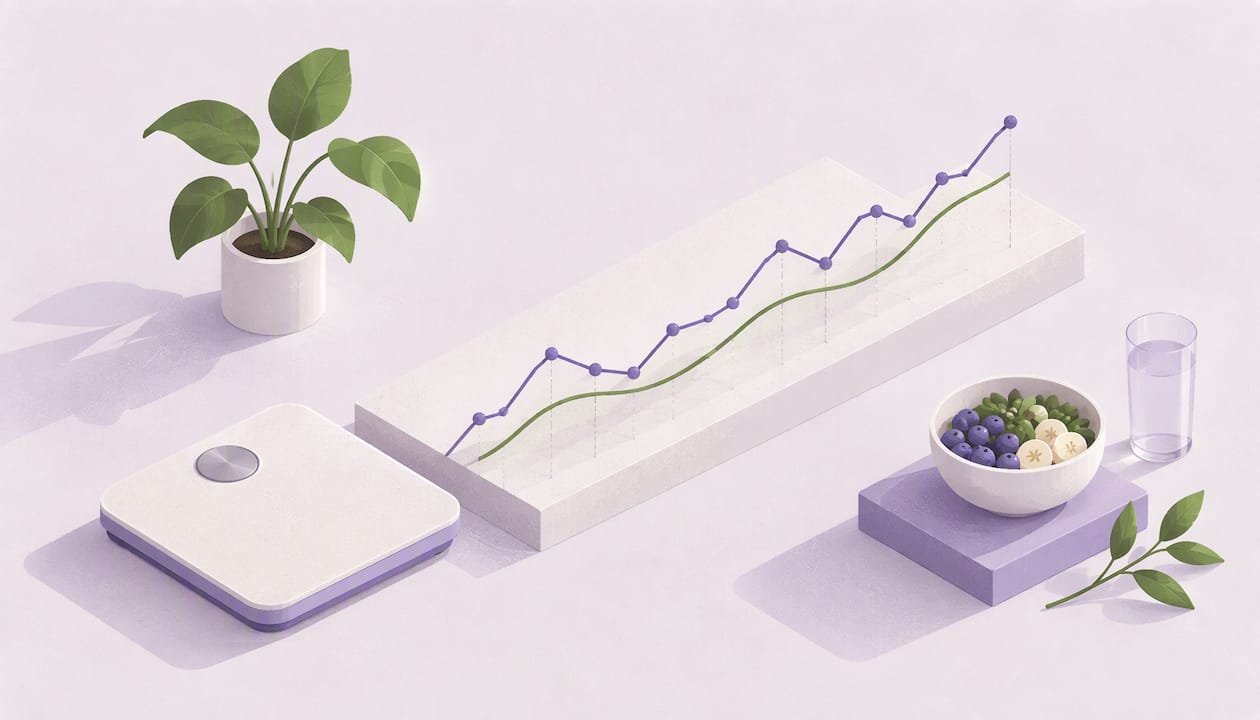
A weight trend is a smoothed estimate of your meaningful body-weight direction that filters out routine daily noise. Judge your progress by how that line moves over days and weeks, not by any single scale reading. When the trend jumps unexpectedly, check your context first: salty meals, hard workouts, travel, or illness often explain it.
TL;DR:
- A seven day moving average filters more noise but responds slowly; a three day window reacts faster while remaining more sensitive to daily swings.
- In a two week study of everyday weight changes, about 84% came from fat free mass, mainly water, rather than fat.
- Daily weigh ins under consistent conditions give smoothing methods more data; weighing only a few times weekly makes moving averages respond more slowly.
- The NHS flags unexplained loss above 5% of body weight over three months as a reason to see a doctor.
Cibo tracks meals and daily nutrition against a personal goal, offering context alongside the weight patterns this article explains.
Get the AppWhat is weight trend analysis, and why does it matter?
Your scale reports a raw number that mixes real tissue change with water, food in your gut, and timing quirks. A trend weight smooths those readings so you see direction instead of static. Here is what that difference gives you:
- Fewer false alarms. A jump after a pizza night barely moves the trend line.
- A clearer direction. You can tell whether your recent readings point down, up, or sideways.
- Better decisions. You adjust calories or activity based on a pattern, not on one bad morning.
- Less emotional whiplash. Daily readings stop feeling like a verdict on your effort.
A trend is a tracking tool, not a clinical test. It cannot tell you why your weight is changing. If you are losing weight without trying, the NHS flags unexplained loss of more than 5% over three months as a reason to see a doctor. Do that rather than waiting for the line to flatten out.
How do moving averages and exponential smoothing calculate a trend?
Both methods turn a noisy series of weigh-ins into a steadier line. They differ in how they treat older data.
- N-day moving average. Add the last N weigh-ins and divide by N. A 7-day window rejects a lot of noise but reacts slowly. A 3-day window reacts faster but stays jumpy.
- Exponential smoothing. Use: Trend_new = Trend_old + α × (Weight_today − Trend_old). The smoothing factor α sets how far the trend moves toward today’s weight. A larger α makes the trend respond more quickly. Exponential smoothing is a standard time-series technique, so the math is well documented.
- Missing days. Many apps fill gaps with linear interpolation: they draw a straight line between the weigh-ins on either side.
Moving averages are easy to compute by hand and easy to explain, but they drop old values abruptly and need a full window of data. Exponential smoothing updates with one simple step and weighs recent days more, though choosing α takes a little judgment.
Why this lag is normal: body-weight models describe weight approaching a new steady state over weeks rather than days, so a smoothed line that trails the scale matches how the body behaves.
What causes weight to swing from day to day?
Most short-term swings are water and food volume, not fat. Glycogen is a good example: each gram of stored glycogen is held with about 2.7 to 3 grams of water, and an average adult carries roughly 500 grams of it. Eat more carbs and you store more glycogen and more water. Cut carbs and the reverse happens.
What the research says: a study of two-week changes under free-living conditions found that about 84% of short-term weight change was fat-free mass, mainly body water, and about 16% was fat mass.
Common causes of a surprising morning number:
- Food volume and the contents of your gut
- A high-sodium meal
- Alcohol
- Menstrual cycle phase
- Medications
- Illness or poor sleep
- A hard workout that leaves muscles holding extra fluid
Healthline notes that swings of several pounds in a day are common, and that weighing at a consistent time makes the average change easier to judge.
How do you compute your own weight trend step by step?
Start with consistent measurement: same scale, same time, same clothing, same spot on a hard floor. Then pick a method.
- Moving average. Add the readings in your chosen window and divide by the number of readings to find the average.
- Exponential smoothing. Start with your current trend and choose a smoothing factor. Each time you weigh in, move the trend partway toward today’s reading. A single unusual reading will have less effect than it would on the raw scale number.
- Handle gaps. If you skip a day, interpolate a straight line between the neighboring weigh-ins. Do not delete honest readings you consider outliers, because the smoothing needs real noise to work properly.
- Judge the change. Compare today’s trend with an earlier trend. A steady slide of about 1 to 2 pounds per week is the gradual pace the CDC describes, and a trend moving much faster deserves a second look at your logs.
Pro Tip: Run both methods side by side. If they tell the same story, trust it; if they disagree, check your logged context for the cause.
What tracking habits make your trend trustworthy?
A good trend needs clean inputs. These habits cover most of it:
- Weigh in the morning after using the bathroom, in minimal clothing, on the same scale and a hard surface.
- Weigh daily if you can. More data points give a smoother, more responsive line. If you weigh only a few times a week, a moving average still works but reacts more slowly and leans harder on each reading.
- Jot a short note when something unusual happens: a salty dinner, a long run, a flight, a stomach bug.
- Pair the line with consistent nutrition logging. Seeing your calories and macros next to the trend shows whether a plateau is real. Our macro calculator and TDEE and calorie tools help you set targets to compare against.
- Keep your activity data nearby. Regular movement supports weight maintenance, and logging it explains many odd weeks. This guide to tracking workout progression shows how to do it without second-guessing every session.
Pro Tip: Write the context note before you step on the scale, so a surprising number never gets to rewrite your story.
Why I trust the line over the number
I’ve watched people quit good plans over one heavy morning. A single reading is a rumor; the trend is the report. The people who stay realistic weigh consistently, log what they eat, and let the smoothed line do the talking. Pairing the two takes the drama out of the process. If you want a gentler relationship with the scale, tracking progress without obsession is a useful read too.
Make trend tracking effortless with Cibo
We built Cibo to help you track your nutrition. Log meals by photo, voice, text, barcode, or manual entry, and we show calories and macros based on USDA data, plus your daily balance against a personal goal. Together mode lets a partner or friend track with you. Cibo works on iOS and Android, with a 7-day trial, then subscription.
FAQ
How much can a 200 lb person lose in a month?
A gradual pace of about 1 to 2 pounds per week is what CDC guidance describes. Individual results vary with diet, activity, and starting point, so judge yours by your trend line.
Why am I 4 lbs heavier than yesterday?
Almost certainly water and food volume, not fat. Sodium, carbohydrates (stored with water as glycogen), alcohol, and gut contents all move the scale quickly. Check your trend line after a few days before reacting.
How often should I weigh myself for trend analysis?
Daily gives the clearest trend, because smoothing methods work best with frequent data. If you weigh less often, a moving average still works, but each reading carries more weight and the line responds more slowly.
Is losing 12 lbs noticeable?
For many people it is, though how it shows depends on height, body composition, and where you carry weight. Your trend line is a better guide than the mirror in the short term. If the loss was unplanned, talk to a doctor.
Sources
Recommended
Not medical advice. Cibo is a nutrition-awareness tool, not a medical device. Read the full disclaimer.
Build healthier habits with Cibo
Nutrition made simpler for everyday life.


