
Daily Protein Intake in 2026: Why 1.2–1.6 g/kg Is the New Focus
Learn what the 1.2–1.6 g/kg guidance means, how it compares with the old RDA, and how to calculate and track your target with food examples.
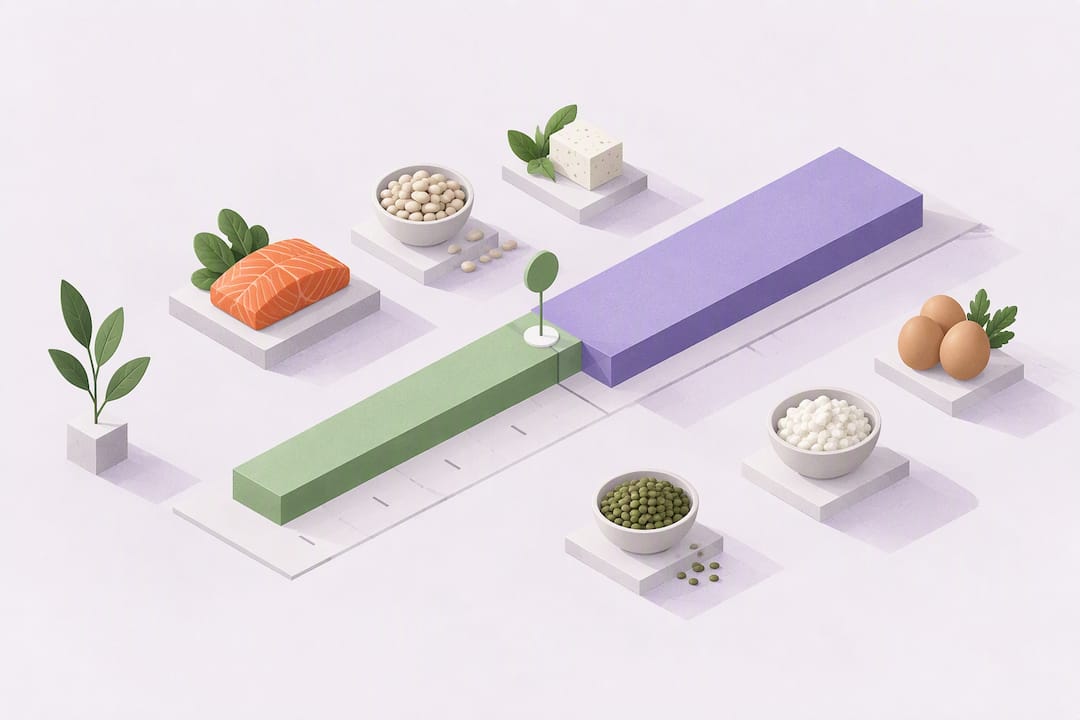
Most healthy adults should aim for about 1.2 to 1.6 grams of protein per kilogram of body weight each day, and if you lift weights regularly, you can lean toward the upper end or go as high as 2.0 g/kg. The old RDA of 0.8 grams g/kg still matters, but it was only ever designed to prevent deficiency, not to help you build muscle or stay full while cutting calories. Grab your weight in kilograms (pounds divided by 2.2), and let’s calculate your real number in the next section.
TL;DR:
- For maintenance and light training, 1.2 to 1.4 g/kg usually suffices; muscle growth or calorie restriction favors at least 1.6 g/kg to protect lean mass.
- Resistance training research found lean mass gains plateau around 1.6 g/kg daily, so intake well above that usually adds little muscle building benefit.
- Spread protein across three to four meals, aiming for 0.25 g/kg per meal for younger adults and about 0.4 g/kg after age 60.
- Plant based eaters can meet muscle building targets with larger portions or complementary foods such as rice and beans, which provide amino acids together.
- Pregnancy, elite competition, and chronic kidney disease can change protein needs; consult a doctor or registered dietitian rather than relying on general targets.
Log meals by photo, voice, text, barcode or manual entry, then see your protein alongside calories, carbs and fat.
Get the AppHow to calculate your daily protein target
The math is simpler than it looks, and once you know your number, you’ll never have to guess again.
The formula: weight in kg × your target g/kg = grams of protein per day. If you only know your weight in pounds, divide by 2.2 to get kilograms first.
- A 150 lb person weighs about 68 kg (150 ÷ 2.2). At 1.2 g/kg, that equates to a practical protein target considered adequate by recent guidance. At 1.6 g/kg, that’s a higher target suitable for those with more intense training.
- A 200 lb person weighs about 91 kg (200 ÷ 2.2). At around 1.4 g/kg, that corresponds to a mid-range protein target. At higher intake levels, approaching 2.0 g/kg, protein needs increase accordingly for more active individuals.
Where you land in the range depends on your goal. If you’re maintaining weight and training lightly, the lower end around 1.2 to 1.4 g/kg usually covers you. If you’re chasing muscle growth or you’re in a calorie deficit trying to hold onto lean mass, push toward 1.6 g/kg or higher, since cutting calories without enough protein makes muscle loss more likely. Our protein target calculator can do this math for you instantly if you’d rather skip the arithmetic.
Why the protein guidance changed: RDA vs. the new targets
For decades, 0.8 grams g/kg was the number everyone quoted, but that figure was always meant as a floor, not a goal. Stanford Medicine’s 2026 commentary now points to 1.2 to 1.6 g/kg/day as a more practical target for many adults, a meaningful jump from the deficiency-prevention minimum.
A large meta-analysis and meta-regression of resistance training studies found that gains in fat-free mass plateau around 1.6 g/kg/day, meaning most people training for muscle don’t get meaningfully more benefit from pushing well past that point. That same body of research supports a broader range of 1.4 to 2.0 g/kg/day for people doing regular resistance training, since individual response varies with training history, age, and how much muscle mass someone is trying to build or preserve.
These aren’t rigid rules. Stanford’s own commentary stresses individualization: calculators give you a starting point, but your age, how long you’ve been training, and your calorie intake should guide where you land inside that range.
How to split your protein across meals and when timing matters
Hitting your daily number matters more than nailing the perfect schedule, but spreading protein across the day helps your body actually use it.
- Aim for roughly 0.25 g/kg of body weight per meal if you’re younger, which works out to about 20 to 40 grams depending on your size.
- If you’re over 60, your muscles may need a bigger per-meal dose, closer to 0.4 g/kg, to trigger the same muscle-building response.
- Three to four meals spread through the day tends to beat loading most of your protein into one sitting.
This comes from research on the “anabolic breakpoint,” the per-meal amount needed to meaningfully stimulate muscle protein synthesis. Older adults show a blunted response to smaller doses, so they typically need more per meal to get the same effect younger people get from less.
Pro Tip: You don’t need to chug a shake the second you finish your workout. Getting enough protein across the whole day, and within about 24 hours of training, matters far more than hitting some narrow post-workout window.
Best protein foods and how plant-based eaters can meet their needs
You don’t need exotic foods to hit your target. A mix of lean meats, dairy, eggs, legumes, and a few plant staples covers most people easily.
- A palm-sized portion of chicken breast or fish is a reliable way to estimate a protein serving without weighing anything.
- Greek yogurt swapped in for regular cereal adds protein without piling on extra calories.
- Combining grains with legumes, like rice and beans, helps plant-based eaters cover their amino acid needs more completely than either food alone.
Leucine, one of the essential amino acids, plays an outsized role in triggering muscle protein synthesis, which is part of why animal proteins (naturally higher in leucine) are often emphasized for muscle-building goals. Plant-based eaters can still hit the same thresholds by eating slightly larger portions or combining sources.
| Food (serving size) | Protein (grams) |
|---|---|
| Chicken breast, cooked | 26 grams |
| Greek yogurt, plain (1 cup) | 23 grams |
| Lentils, cooked (1 cup) | 18 grams |
| Eggs (2 large) | 12 |
| Tofu, firm | 8 grams |
Serving sizes and gram values reflect standard entries from USDA FoodData Central, the reference most nutrition tools, including ours, pull from for accuracy.
Who should aim higher or lower, and when to check with a professional
Your ideal number isn’t static. It shifts based on your training, your age, and whether you’re cutting calories.
- Resistance trainees generally benefit from the upper range, around 1.6 to 2.0 g/kg, since lifting increases the amount of protein your muscles can use for repair and growth.
- Older adults often do better closer to 1.2 to 1.6 g/kg or higher, since aging reduces how efficiently the body responds to protein.
- People in a calorie deficit for fat loss should lean toward the higher end of their range to help protect lean mass while losing weight.
If you’re pregnant, training at an elite competitive level, or managing a condition like chronic kidney disease, your protein needs may fall outside these general ranges entirely. Those situations call for a conversation with a doctor or registered dietitian rather than a one-size-fits-all number from an article.
How to track your protein and sample meal plans that hit your target
Protein is also commonly discussed as a share of your total calories, not just grams. Since protein provides 4 calories per gram, you can convert your gram target into a percentage of your daily intake. The Acceptable Macronutrient Distribution Range sets protein at 10% to 35% of total calories, and many people aiming for muscle gain or fat loss find that aiming for around a quarter of their daily calories from protein aligns well with their activity level.
Here’s what that looks like in practice:
- On a 2,200-calorie maintenance day, a target of about 110 grams of protein (roughly 20% of calories) might come from eggs at breakfast, grilled chicken at lunch, and salmon with lentils at dinner.
- On a 2,800-calorie higher-activity day, a target closer to 150 grams (about 21% of calories) could come from Greek yogurt and oats in the morning, a turkey and rice bowl at lunch, and steak with beans at dinner.
Logging each meal by hand gets tedious fast, which is why we built our app around photo, voice, text, barcode, and manual logging that pulls calorie and macro data straight from USDA FoodData Central. If you want to see exactly how your meals stack up against your personal protein target, our macro calculator turns your numbers into a daily gram plan in a few taps.
The one habit that actually moves the needle
If you take one thing from all this research, let it be this: pick a g/kg number this week and start logging, even loosely. Most people overthink the exact decimal point and underthink consistency, which is the real lever here.
Protein targets matter, but they only work alongside regular resistance training. The two together, tracked honestly over weeks rather than days, do more for your results than any single number ever will.
Track your protein without the mental math
Once you know your target, the hard part is sticking with it, and that’s where we come in. Our app lets you log meals by photo, voice, text, barcode, or manual entry, then shows your protein, carbs, and fat against your personal daily goal, all built on USDA FoodData Central so the numbers hold up.
If you’re working toward a target with a partner or friend, our Together mode lets you track side by side and keep each other accountable. Try it with a 7-day trial, then subscription, on Cibo, available for iOS and Android.
- AI photo logging that estimates calories and macros from a single picture.
- Voice, text, barcode, and manual entry for whichever method fits the moment.
- Daily protein, carb, and fat balance tracked against your personal goal.
Start with our protein calculator to find your number, then log your first meal to see how close you already are.
This article is general information, not a substitute for advice from a qualified doctor. Consult a qualified healthcare professional about your own circumstances before acting on anything here.
FAQ
Is 30 grams of protein a day too much?
No, 30 grams a day is well below what most adults need. Most healthy adults should target between 82 and 109 grams daily depending on body weight, based on the 1.2 to 1.6 g/kg guidance, so 30 grams total for the day would fall far short for the large majority of people.
Is 100 grams of protein a day enough?
For many adults around 68 kg (150 lb), 100 grams a day lands within or close to the recommended 1.2 to 1.6 g/kg range. Whether it’s enough depends on your body weight and activity level, so it’s worth running your own numbers with a protein calculator.
Is eating two eggs a day too much protein?
No, two eggs provide about 12 grams of protein, a modest contribution toward a daily target that typically falls between 82 and 109 grams depending on body weight and training goals. Eggs work well as one source among several throughout the day rather than a standalone protein strategy.
How much protein do you need by age?
Younger adults generally do well with the standard 1.2 to 1.6 g/kg range, while older adults often benefit from targets at the higher end or above it, since aging reduces how efficiently the body uses protein per meal. If you have a specific medical condition affecting protein needs, a doctor or registered dietitian can help tailor a number for your situation.
Recommended
Not medical advice. Cibo is a nutrition-awareness tool, not a medical device. Read the full disclaimer.
Build healthier habits with Cibo
Nutrition made simpler for everyday life.


