
Find Food Calories Fast Using USDA Data in 7 Steps
Use USDA FoodData Central to get accurate calories for any food. Follow seven quick steps to weigh, match, and log meals faster.
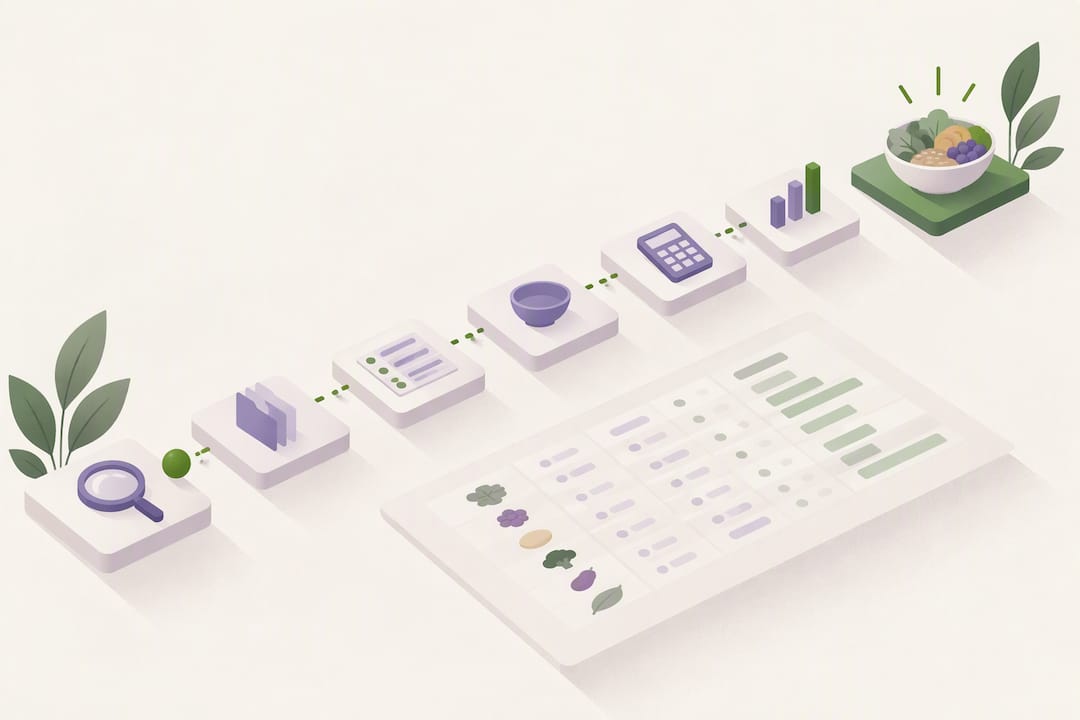
The fastest reliable way to find calories in food is the Nutrition Facts label for anything packaged, and USDA FoodData Central for raw or homemade foods without a label. Pick one trustworthy number, then scale it to the exact amount you ate, whether that is by weight, by serving count, or by the fraction of the package you finished. For mixed meals or restaurant dishes, a photo-based app fills the gap, though it works best as a starting estimate rather than a precise figure.
TL;DR:
- Always verify whether the food is raw or cooked when checking calorie data, as cooking can change calorie density.
- Use kitchen scales and total recipe calculations to improve accuracy for homemade dishes instead of estimating portions by eye.
- Rely on USDA FoodData Central or branded product labels for raw or packaged foods, and double-check barcode matches before logging.
- The 4/4/9 calorie rule provides a good estimate but can be inaccurate for foods like nuts that are less fully digestible.
- Most errors in calorie tracking stem from misidentifying foods or misjudging portion sizes, rather than inaccuracies in the standard energy calculations.
Cibo lets you log meals by photo, voice, text, barcode, or manual entry, with nutrition data based on USDA FoodData Central.
Get the AppQuick ways to look up calories for any food
Your method should match the food in front of you. A few options cover almost every situation:
- Packaged foods: Read the Nutrition Facts label, then multiply by how many servings you actually ate, not just one listed serving.
- Branded products: Search for the product’s own label entry in a branded food database rather than a generic match, since recipes vary between brands.
- Raw or minimally processed foods: Use USDA FoodData Central directly. It is the reference point most nutrition apps build on.
- Barcode scanning: Fast for packaged goods, but double check that the scanned item matches the flavor, size, and brand on your shelf.
- Photo or AI logging: Convenient for homemade or mixed meals, though portion size is harder for any tool to judge from an image alone, so treat the number as a reasonable estimate rather than gospel.
Each method has a trade-off between speed and precision. Packaged food with a label is nearly instant and reliable. A bowl of homemade chili photographed on your counter asks more of the tool, and of you, to land close to accurate.
A step-by-step way to get an accurate calorie number
Getting a number you can trust takes a few extra seconds, and it is worth it if you are tracking closely.
- Identify the exact food and its data type. USDA FoodData Central organizes entries into Foundation, Branded, FNDDS, and SR Legacy data, and choosing the wrong one skews your number before you even start, according to the Foundation Foods documentation.
- Confirm raw versus cooked. A raw chicken breast and a grilled one carry different calorie density per gram once moisture cooks off, so match the entry’s state to what is on your plate.
- Check the unit. Some entries list calories per 100 grams, others per serving. Mixing these up is one of the easiest ways to double or halve your number by accident.
- Weigh or measure the portion. A kitchen scale removes most of the guesswork that a measuring cup leaves behind.
- Account for added ingredients. Oil in the pan, dressing on the salad, and butter on the toast all carry calories that a plain food search will miss.
- For homemade dishes, total the whole batch. Add up calories for every ingredient in the finished, cooked, edible batch, weigh that finished batch, divide to get calories per gram, then multiply by the weight of your actual portion.
- Log macros alongside calories. Protein, carbs, and fat give you context calories alone cannot, and if you are managing a medical condition, a doctor or dietitian can help set targets that fit your situation.
Pro Tip: Weigh your cooked batch once, write down the per-gram number, and you can skip re-weighing the whole recipe every time you make it again.
Where the 4/4/9 rule fits and where it falls short
The 4/4/9 rule estimates energy at 4 calories per gram of protein, 4 per gram of carbohydrate, and 9 per gram of fat, with alcohol commonly counted at 7 calories per gram. It is a handy mental shortcut, and FoodData Central’s own FAQ notes that the database often reports energy using these general Atwater factors, though it sometimes uses food-specific factors instead.
A peer-reviewed feeding study found that almonds’ actual metabolizable energy measured around 4.6 calories per gram, well below the roughly 6.0 calories per gram predicted by standard Atwater factors, according to research published in PMC. That gap shows why recalculating calories from scratch with 4/4/9 math can drift from reality for certain foods, especially nuts and fibrous plants where not everything gets digested the way the formula assumes.
For everyday logging, the practical move is to trust the number already sitting in the database or printed on the label rather than recomputing it yourself, saving the manual math for the rare case where no database entry exists at all.
Common mistakes that throw off your calorie count
Small missteps add up fast when you are tracking daily intake:
- Matching the wrong state. Logging raw oats when you ate them cooked (or the reverse) changes the number more than people expect.
- Forgetting added fats. A tablespoon of olive oil in the pan or a drizzle of dressing can add more calories than the vegetables underneath.
- Skipping the servings-per-container check. A bag labeled 2.5 servings means you need to multiply, not assume the whole bag is one serving (see the FDA guide to the Nutrition Facts label).
- Trusting a shaky barcode match. Scanned items occasionally pull up the wrong size or flavor variant, so a quick glance at the product name catches most errors.
Pro Tip: When a number looks off, cross-check the branded label against the closest USDA entry, and when you’re logging without a scale at all, a few portion-estimating habits can still keep you close.
A USDA-backed app workflow in practice
We built our app around the same sources this workflow relies on. Whole foods logged by photo, voice, text, or manual entry are matched to USDA FoodData Central, and packaged foods scanned by barcode to Open Food Facts label data, the same kinds of sources behind the checks described above. That number then feeds into your daily balance against a personal goal, so you can see where you stand without doing any of the math yourself.
Together mode lets a partner or friend follow the same log, which helps when you are both trying to stay consistent. Our app supports both iOS and Android.
The number matters less than the match
Chasing a slightly more precise calculation method is rarely where the biggest accuracy gains hide. Most tracking errors come from logging the wrong food entry or guessing at portion size, not from the difference between a general and a specific Atwater factor. Get the food identity and the weight right first, and the method you use to calculate it becomes a minor detail. If you are managing a medical condition or have specific nutritional needs, a registered dietitian or your doctor can set targets that general tracking advice cannot.
Try a faster way to log what you eat
Reading labels and matching USDA entries works, but it takes time most days don’t have. Our app handles that lookup for you: snap a photo, scan a barcode, say it out loud, or type it in, and we estimate calories and macros from USDA data for whole foods and label data for packaged ones, then show your daily balance against your goal. Together mode keeps a partner or friend in the loop if you’re tracking as a team.
- Photo, voice, text, barcode, or manual entry: log a meal however is fastest in the moment.
- Daily balance: see where you stand against your own goal, not a generic target.
- Together mode: track alongside a partner or friend for shared accountability.
Try Cibo with a 7-day trial, then subscription, to see if it fits how you eat.
FAQ
How can I find calories in food?
Check the Nutrition Facts label for packaged items, or search USDA FoodData Central for raw and homemade foods. For mixed meals, a photo-logging app that pulls from USDA data gives a fast working estimate.
What does the 4/4/9 rule for calories mean?
The 4/4/9 rule estimates energy at 4 calories per gram of protein, 4 per gram of carbohydrate, and 9 per gram of fat, with alcohol at 7 calories per gram. FoodData Central notes it often uses these general factors but sometimes reports food-specific ones instead.
What is an app that can scan food for calories?
Several apps scan barcodes or photos to estimate calories, including Cibo, which uses USDA FoodData Central for whole foods and Open Food Facts label data for packaged products. Accuracy still depends on matching the right product and portion size.
How do we actually know how many calories are in food?
Calorie values typically come from lab analysis or from calculation using Atwater factors applied to a food’s protein, carbohydrate, and fat content. Those factors are general estimates, and research on almonds found the actual measured energy value came in notably lower than the Atwater-predicted figure, showing the method has real limits for certain foods.
Sources
- How to understand and use the Nutrition Facts label — FDA
- Discrepancy between the Atwater factor predicted and empirically measured energy values of almonds in human diets — PMC
Recommended
Not medical advice. Cibo is a nutrition-awareness tool, not a medical device. Read the full disclaimer.
Build healthier habits with Cibo
Nutrition made simpler for everyday life.


