
How to Count Calories Without Weighing Food
You don't need a kitchen scale to track calories. Here are seven reliable ways to estimate portions accurately - hand sizes, common objects, and photo logging.
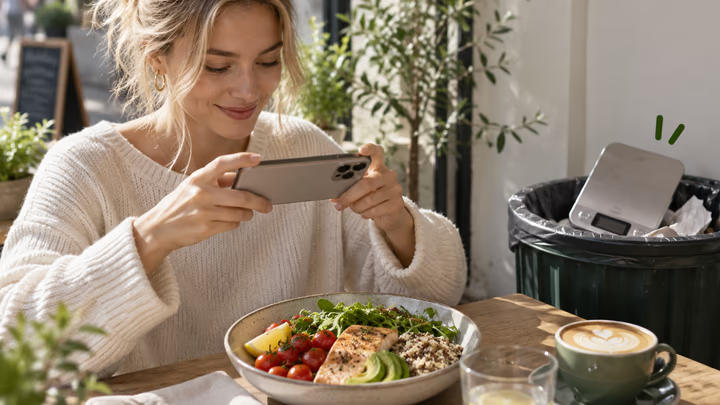
A kitchen scale is the most accurate way to count calories. It is also the reason a lot of people quit. Weighing every ingredient works at home on a quiet Sunday; it falls apart at a restaurant, at a friend's dinner table, or on a Wednesday when you are simply too busy. The good news is that you can track calories accurately enough to lose or maintain weight without ever touching a scale - if you know how to estimate.
Accuracy, not precision, is what matters. You do not need every meal logged to the gram. You need your weekly average to be close enough that the trend on the scale reflects reality. Research on self-reported intake shows most people undercount by 20-40%, so the goal of estimating well is simply to shrink that error. Here is how.
1. Use your hand as a portable measuring set
Your hand travels with you and scales roughly with your body size, which makes it a surprisingly good portion guide:
- Palm (not fingers) ≈ one protein serving - about 20-30 g of protein. That is roughly a chicken breast portion.
- Cupped hand ≈ one serving of carbs - about a half cup of cooked rice, pasta, or oats.
- Fist ≈ one cup of vegetables or a piece of whole fruit.
- Thumb ≈ one tablespoon of a fat like peanut butter, oil, or butter - the foods most often underestimated.
The hand method is fast and always available. It will not match a scale, but it keeps the biggest offenders - calorie-dense fats and heaped grains - from drifting out of control.
2. Anchor yourself with common objects
Visual anchors turn abstract grams into things you can actually picture:
- A deck of cards ≈ 3 oz (85 g) of cooked meat or fish.
- A tennis ball ≈ one cup (a fruit, a serving of pasta).
- A golf ball ≈ ¼ cup (nuts, dried fruit, shredded cheese).
- A poker chip ≈ one tablespoon.
- Your thumb tip ≈ one teaspoon.
Spend one week comparing these to a scale at home and they lock into memory. After that you carry the reference everywhere.
3. Learn the numbers for the ten foods you actually eat
Most people eat the same 20 or so foods on repeat. You do not need a database of 10,000 items memorized - you need the calories in your staples. Look up the foods you eat most often once, and the estimates come automatically after that. A medium banana is about 105 calories; a cup of cooked white rice is about 205. Once those are second nature, a plate becomes easy arithmetic instead of a research project. Our calorie database lists per-100 g and per-serving numbers for common foods to help you build that mental library.
4. Standardize your servingware
The dishes you use every day are measuring tools you have already calibrated. Weigh what your usual cereal bowl holds when full, or how much coffee your mug takes, once - and then every future bowl and mug is pre-measured. The same works for the ladle you use for soup and the scoop in your protein tub. You are not eyeballing anymore; you are reading an instrument you already own.
5. Count in units, not grams, for packaged food
Anything with a label is already counted for you. A slice of bread, a tablespoon of dressing, one square of chocolate, a single wrapped cheese - the packaging tells you the calories per unit. The trick is honesty about the unit count: two tablespoons of dressing is a real serving, but the pour most people use is closer to four. Count the pumps, the slices, and the squares, and packaged food needs no scale at all.
6. Take a photo - even if only for yourself
A photo of your plate before you eat does two things. First, it creates an honest record you cannot rationalize away later. Second, it captures the visual detail - the second scoop of rice, the drizzle of oil - that memory quietly edits out by dinnertime. Studies on photographic food journaling consistently find it produces more accurate records than recall alone, precisely because it removes the guesswork of “what did I actually have?”
This is exactly where an AI tracker earns its place. Instead of you estimating from the photo, Cibo reads the plate and returns calories and macros in seconds - no scale, no database search, no manual entry. It is estimation done for you, with the accuracy of a tool that has seen millions of meals.
Let the camera do the counting. Snap a photo, get calories and macros instantly, and skip the weighing entirely.
7. Round up, not down
When you are unsure, estimate high. The universal bias in self-reporting runs one direction - downward - so a deliberate upward nudge cancels it out. If a restaurant pasta looks like it could be 600 or 800 calories, log 800. Over a week, rounding up on the uncertain items keeps your total honest, and honest totals are what move the scale.
How accurate do you really need to be?
Close enough to see a trend. If you are eating in a genuine deficit, your weight will fall over two to three weeks even with 10-15% estimation error. If the trend stalls, you tighten up - weigh a few of the calorie-dense items (oils, nut butters, cheese) that carry the most error per gram, and leave the vegetables alone. That targeted approach gets you most of the accuracy of full weighing for a fraction of the effort.
The best tracking method is the one you will still be using in six months. For most people that is not a scale on the counter - it is a set of reliable estimates, a short list of memorized staples, and a camera in their pocket. Build those three, and you can count calories anywhere, for as long as you want to.
Ready to stop guessing? Browse the calorie database to memorize your staples, or let Cibo read your next meal from a photo.
Not medical advice. Cibo is a nutrition-awareness tool, not a medical device. Read the full disclaimer.
Build healthier habits with Cibo
Nutrition made simpler for everyday life.


