
Macro Split for Weight Loss: Set Protein at 1.6–2.4 g/kg
Set a calorie deficit, calculate protein in grams per kilogram, protect a fat floor, and use USDA food data and Cibo’s calculator to set carbs for daily...
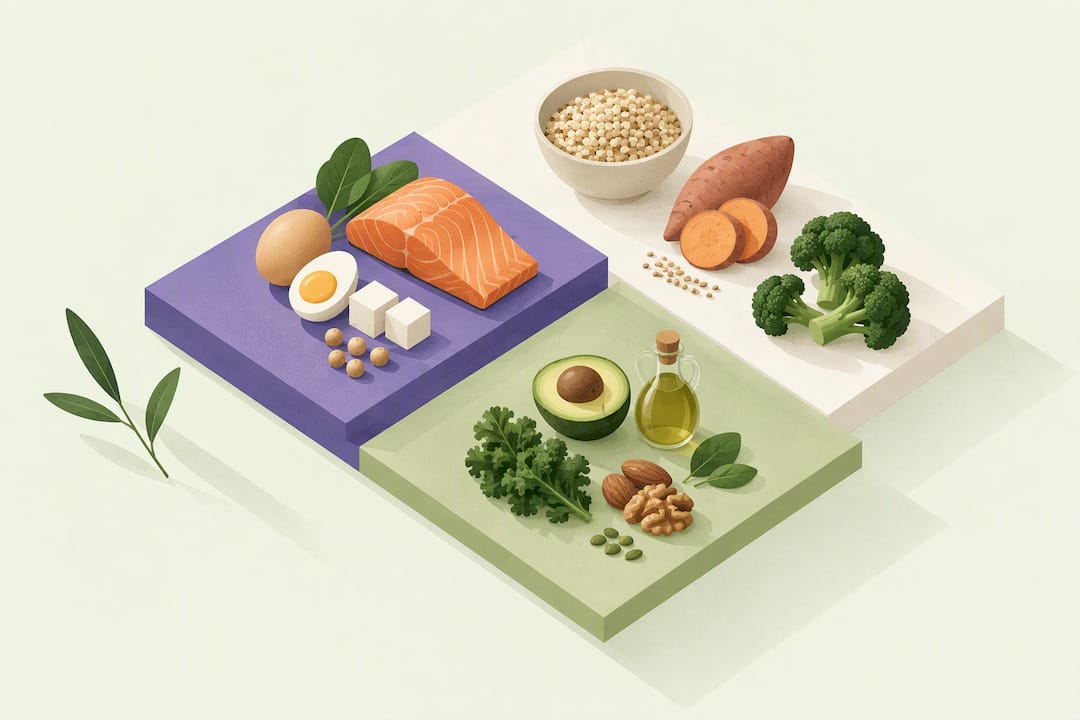
Set your calorie deficit first, then lock your protein in grams per kilogram of body weight, set a minimum fat floor, and let carbohydrates fill whatever calories remain. A practical deficit for steady, sustainable fat loss sits around 300 to 500 calories a day, protein lands between 1.6 and 2.4 grams per kilogram, and fat should not drop below roughly 0.5 grams per kilogram. You can run these numbers yourself with USDA FoodData Central values and a macro calculator in a few minutes.
TL;DR:
- Older adults and people taking appetite suppressing medication should prioritize protein at each meal, while lower activity adults can use the lower end.
- People doing high volume resistance training or cardio can allocate more carbohydrates around workouts, while sedentary days generally need less to replace muscle glycogen.
- Log drinks, oils, and sauces, compare seven day weight averages, and wait two weeks before adjusting calories by roughly 150 to 200 kcal.
- Aim for at least 25 grams of fiber and 400 grams of fruits and vegetables daily, choosing whole foods for fullness and broader micronutrient intake.
- Low carb and low fat approaches produce similar fat loss when calories and protein match, so choose the split you can maintain long term.
Log meals by photo, voice, text, barcode or manual entry, then see your calories and macros against your personal daily goal.
Get the AppHow do you calculate macros for weight loss?
The math works best in one direction: calories, then protein, then fat, then carbs. Skipping that order is how people end up with a percentage split that looks tidy on paper but leaves them under-fed on protein or starving for energy on training days.
Start with your total daily energy expenditure, or TDEE. The Mifflin-St Jeor equation estimates your resting metabolic rate from your weight, height, age, and sex, then you multiply that number by an activity factor to get your maintenance calories. From there, subtract your deficit. A 300 to 500 kcal cut below maintenance is a reasonable starting point for most adults chasing steady, sustainable fat loss, according to Healthline’s review of macronutrient ratios.
Once you know your daily calorie target, the grams follow in this order:
- Calculate TDEE using a formula like Mifflin-St Jeor plus an activity multiplier, or use a calorie deficit calculator to skip the arithmetic.
- Subtract your deficit (300 to 500 kcal) to land on your daily calorie target.
- Set protein in grams per kilogram of body weight, not as a percentage of calories.
- Set a fat floor in grams per kilogram, prioritized before carbs.
- Fill the remaining calories with carbs, converting grams using the energy factors below.
Protein and carbs both provide 4 calories per gram, while fat provides 9. Those conversion factors, used in nutrition labeling, are what let you move between grams and calories in either direction.
| Macronutrient | Calories per gram | Typical role in the split |
|---|---|---|
| Protein | 4 | Set first in g/kg, protects lean mass |
| Fat | 9 | Set as a floor, supports hormone health |
| Carbohydrate | 4 | Fills remaining calories, fuels training |
Say your target is 1,800 calories a day. If protein works out to 150 grams, that’s 600 calories. If your fat floor lands at 65 grams, that’s 585 calories. Subtract both from 1,800 and you have 615 calories left, which divided by 4 gives you about 154 grams of carbs. The percentages fall out automatically once the grams are set, which is the opposite of how most people try to do this.
What are the right protein targets for fat loss?
Protein is the macro that protects muscle while you’re in a deficit, which is exactly the tissue you want to keep when the scale moves down. Evidence-based guidelines support a range of 1.6 to 2.4 grams per kilogram of body weight for active adults working on fat loss, which translates to roughly 0.73 to 1.1 grams per pound.
Research supports protein in the 1.6 to 2.4 g/kg range for preserving lean mass during a deficit, a finding consistent across peer-reviewed studies on energy restriction and body composition. For a typical adult, this range translates to a moderate to higher daily protein intake, allowing flexibility based on training and individual needs.
Where you land in that range depends on context:
- Aggressive deficits (closer to 500 kcal or more) call for the higher end, since bigger calorie cuts put more lean mass at risk.
- Older adults often do better closer to 2.0 to 2.4 g/kg, since muscle-building signals become less efficient with age.
- People using GLP-1 medications benefit from prioritizing protein at every meal, since appetite suppression can make it easy to under-eat protein without noticing.
- Lower-activity adults on a modest deficit can sit comfortably at the lower end, around 1.6 g/kg, without losing ground.
Spreading protein across three or four meals, rather than loading it all at dinner, makes the target easier to hit and easier to digest. A palm-sized portion of chicken breast, a cup of Greek yogurt, or a can of tuna each land in the 20 to 30 gram range, and checking exact values against USDA FoodData Central removes the guesswork. Readers who want a GLP-1-specific angle on grams-first protein planning can find more detail in coaching guidance built around calories-first macros.
Why set a fat floor before filling in carbs?
Fat does more than sit on a macro chart. It supports hormone production and the absorption of fat-soluble vitamins, which is why cutting it too aggressively to make room for carbs tends to backfire over time. A reasonable floor is 0.5 to 1.0 grams per kilogram of body weight, or roughly 20% or more of total calories, a range consistent with WHO guidance on limiting total fat to about 30% or less of energy while still leaving room above the floor. Research on fat intake and health backs the idea that a fat floor should be protected rather than treated as the macro you cut first.
Carbs are the flexible macro, which means they should expand or shrink based on how much you train:
- Sedentary or lightly active days can run lower on carbs, since there’s less glycogen demand to replace.
- High-volume resistance training or cardio benefits from more carbs, since glycogen stores fuel performance and recovery.
- Rest days during a heavy training block can still carry moderate carbs to support recovery, rather than cutting them to zero.
Pro Tip: Shift a larger share of your daily carbs to the meal right before or after your workout. It won’t change your total calories, but it can make training feel noticeably less flat.
Worked examples: how the same method produces different splits
The order of operations stays identical across people, but the resulting percentages can look wildly different depending on body weight, activity, and how aggressive the deficit is. That’s the part most percentage-based advice misses: the same 30% fat target means a different number of grams for a 55 kg person versus a 95 kg person.
Here are three scenarios run through the same four steps.
- Small, sedentary adult, 55 kg, modest deficit. TDEE comes out around 1,900 calories; a 300 kcal deficit sets the target at 1,600. Protein at 1.8 g/kg is 99 grams (396 calories). Fat floor at 0.7 g/kg is 39 grams (351 calories). Remaining calories: 853, or about 213 grams of carbs.
- Active resistance trainee, 75 kg, moderate deficit. TDEE lands near 2,600; a 400 kcal deficit sets the target at 2,200. Protein at 2.0 g/kg is 150 grams (600 calories). Fat floor at 0.8 g/kg is 60 grams (540 calories). Remaining calories: 1,060, or about 265 grams of carbs.
- Lean athlete, 68 kg, aggressive cut. TDEE sits around 2,400; a 500 kcal deficit sets the target at 1,900. Protein at 2.4 g/kg (the higher end for an aggressive cut) is 163 grams (652 calories). Fat floor at 0.6 g/kg is 41 grams (369 calories). Remaining calories: 879, or about 220 grams of carbs.
| Scenario | Calories | Protein (g) | Fat (g) | Carbs (g) |
|---|---|---|---|---|
| Sedentary, 55 kg | 1,600 | 99 | 39 | 213 |
| Active trainee, 75 kg | 2,200 | 150 | 60 | 265 |
| Lean athlete, aggressive cut | 1,900 | 163 | 41 | 220 |
Notice that the athlete’s protein share works out close to 34% of calories, while the sedentary adult’s protein share is closer to 25%, even though both followed the identical grams-first method. Percentages are a byproduct, not a target. When you build your own numbers, record four figures and nothing else: protein grams, fat grams, carb grams, and total calories. A worked calculator walkthrough can confirm your math if you want a second check.
How do you track and adjust macros once you’re logging?
Logging consistently matters more than logging perfectly. Use entries validated against USDA data so your numbers reflect what you actually ate, not a rough guess, and check your weight as a weekly average rather than reacting to single-day swings, since water retention and digestion can shift the scale by a kilogram or more in either direction.
- Log every meal, including drinks and cooking oils, since small additions add up over a week.
- Average your weight across seven days before deciding anything has changed.
- Hold steady for two weeks before adjusting, since short-term plateaus are normal.
- Adjust calories in small steps, around 150 to 200 kcal, rather than large cuts that are harder to sustain.
- Change macros only after calories are stable, so you can tell which variable actually moved the needle.
Pro Tip: Track protein consistency before you worry about anything else. If protein is hitting target most days, your deficit is doing the real work and small drifts in fat or carbs rarely matter.
Watch for a few common logging errors: skipping cooking oils and sauces, eyeballing portions instead of weighing them, and forgetting that a “serving” on a label may not match what you actually put on your plate.
How Cibo and this guide fit together
This method works best when the logging is fast enough that you’ll actually stick with it. Every calorie and macro figure in this guide traces back to USDA FoodData Central, the same database behind Cibo’s food entries, so the grams-first numbers you calculate here match what shows up when you log a meal.
You can log by photo, voice, text, barcode, or manual entry, then see your daily balance against the protein, fat, and carb targets you set using this method. Tracking alongside a partner or friend can help with the consistency this approach depends on.
This guide is written by Orest Rodkin.
Where do fiber and micronutrients fit into a macro plan?
Macros get the spotlight, but fiber and micronutrients decide how well a deficit actually feels day to day. WHO guidance recommends at least 25 grams of fiber daily alongside at least 400 grams of fruits and vegetables, and fiber-rich carb sources tend to be more filling per calorie than refined ones, which matters when you’re already working with a reduced budget.
Vegetables, legumes, and whole fruit are the easiest way to hit a fiber target without crowding out protein or fat. A cup of sliced mushrooms runs about 15 calories, which means you can build volume into meals without spending much of your carb allowance.
Micronutrients matter just as much, even though they don’t show up on a macro breakdown. A deficit that’s low in iron, calcium, or B vitamins can leave you fatigued in a way that has nothing to do with calories or protein. Choosing a variety of vegetables, whole grains, and lean proteins rather than the same three foods on repeat covers more of that ground automatically, without adding a separate tracking step to your day.
What actually matters more than the perfect split
Chasing a flawless percentage split is the wrong fight. The research comparing low-carb and low-fat diets shows similar fat loss outcomes when calories and protein are matched, so the split you can stick with for months beats the one that looks optimal on a spreadsheet for two weeks.
Pair this approach with resistance training to protect the muscle your protein target is already working to preserve, and loop in a doctor or dietitian if you’re managing a medical condition or taking medication that affects appetite or metabolism. Use the calculators and tracking habits above as your working system, then adjust them as your results tell you what’s next.
Try the calculator-driven workflow in Cibo
Running the math by hand works, but it’s faster with a tool that does the conversions for you. Cibo’s macro calculator takes your calorie target and turns it into protein, fat, and carb grams using the same order of operations covered in this guide, and every food you log afterward pulls from USDA-sourced values for accuracy.
What that looks like in practice:
- Set your TDEE and deficit, then get protein, fat, and carb grams instantly.
- Log meals by photo, voice, text, barcode, or manual entry.
- See your daily balance against your targets, updated as you log.
- Use Together mode to track alongside a partner or friend for shared accountability.
A 7-day trial, then subscription, gives you full access to AI meal logging on iOS and Android. Start with the macro calculator and build your numbers for today.
This article is general information, not a substitute for advice from a qualified doctor. Consult a qualified healthcare professional about your own circumstances before acting on anything here.
FAQ
What is a good macro split for fat loss?
A good split starts with grams, not percentages: protein around 1.6 to 2.4 g/kg of body weight, a fat floor near 0.5 to 1.0 g/kg, and carbs filling whatever calories remain after a 300 to 500 kcal deficit. The resulting percentage split will vary by person, and that variation is normal.
Is a 40/30/30 macro split good for weight loss?
A 30/30/30 split (carbs/protein/fat) can work for some people, but percentages alone don’t account for body weight or activity level. Converting those percentages to grams for your specific calorie target, then checking the protein and fat numbers against evidence-based ranges, is a more reliable check than the percentages on their own.
Is a 50/25/25 macro split good?
It depends entirely on the grams that percentage produces once applied to your calorie target. A split skewed toward higher carbs and lower protein could land someone’s protein well below the 1.6 g/kg range supported for lean mass preservation, so it’s worth converting to grams and comparing before assuming the split fits.
What is the 3-3-3 rule to lose weight?
There’s no single, widely recognized clinical definition of a “3-3-3 rule” for weight loss backed by a government or peer-reviewed source. If you’ve seen it referenced online, treat it as informal advice rather than an evidence-based guideline, and rely on calorie deficit and protein-target math instead.
How do I calculate my macros for weight loss?
Start with your TDEE, subtract a 300 to 500 kcal deficit, then set protein in grams per kilogram before setting a fat floor and letting carbs fill the rest. A macro calculator can run these steps for you once you have your calorie target.
Sources
- PubMed: protein intake recommendations (peer-reviewed article)
- WHO updates guidelines on fats and carbohydrates (World Health Organization)
- The Best Macronutrient Ratio for Weight Loss — Healthline
Recommended
Not medical advice. Cibo is a nutrition-awareness tool, not a medical device. Read the full disclaimer.
Build healthier habits with Cibo
Nutrition made simpler for everyday life.


