
Calorie Tracking Burnout: How to Reset Without Quitting
Tired of logging every bite? Learn the signs of calorie tracking burnout, how to lighten your routine, and when to pause or talk to a professional.
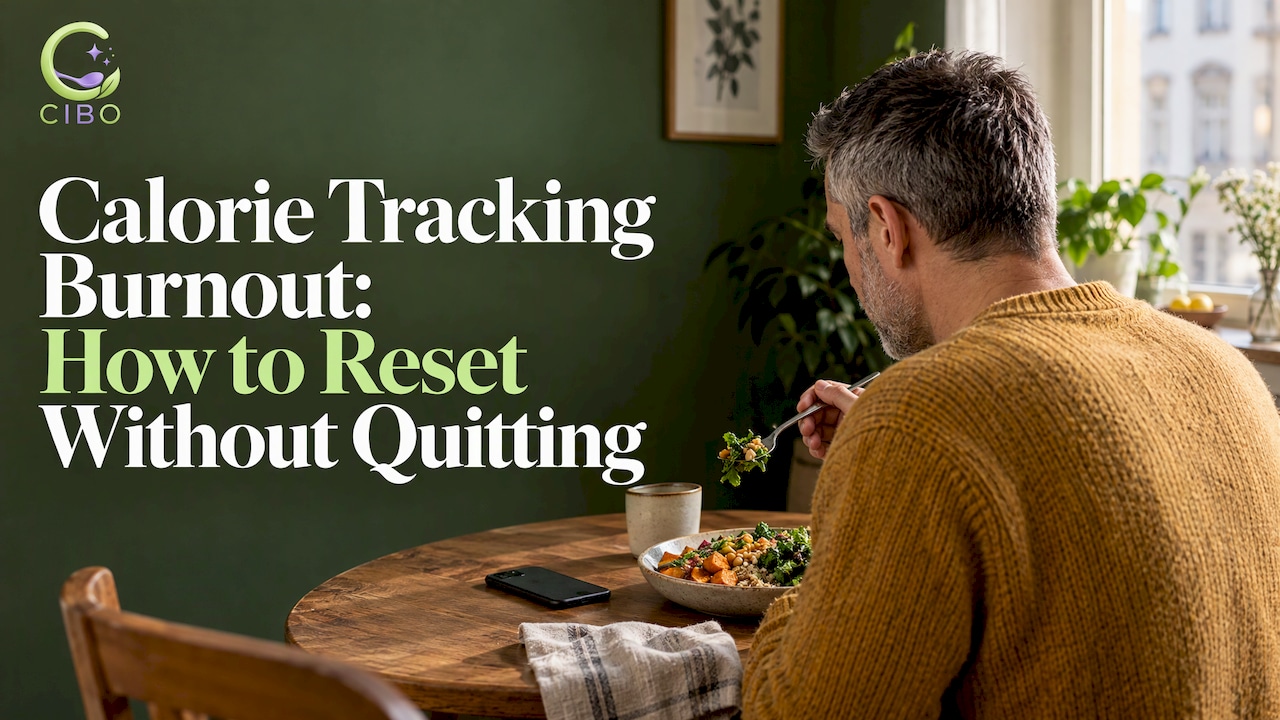
Calorie tracking burnout is the point where logging food stops feeling useful and starts feeling like a chore, a source of stress, or a scoreboard you dread. The fix is usually not to abandon awareness of what you eat. It is to make tracking lighter: faster logging, ranges instead of exact numbers, and planned breaks. If you want a tool that keeps the work to a few seconds, Cibo lets you log by photo, voice, text, barcode or manual entry and shows your daily balance against a personal goal, so the routine takes up less of your day.
Below you will find how to tell tired from truly stressed, a step-by-step reset, and the situations where stepping back or talking to a professional is the right move.
Cibo lets you log meals by photo, voice, text, barcode or manual entry, then see your daily balance against a personal goal.
Get the AppTL;DR
- Burnout is common and fixable: most of it comes from too much effort per log, too much precision, and too much judgment attached to numbers.
- Think in ranges, not exact figures. Calorie counts are estimates, and self-reported intake is often underreported by as much as 30%.
- Track in cycles: a three- to seven-day audit every few months, with simpler habits in between.
- If tracking brings guilt, dread or constant food thoughts, pause and talk to a doctor or registered dietitian. If you have a history of an eating disorder, do that before counting at all.
What calorie tracking burnout looks like
Burnout rarely arrives with a single bad day. It builds. You skip logging lunch because it feels like homework, then dinner, then the whole weekend, and then you feel behind and a little guilty about it.
There are two flavors worth separating.
Fatigue burnout is about effort. Signs include:
- Logging feels slow, so you postpone it and then forget what you ate.
- You are bored of searching for foods and comparing similar database entries.
- Eating out feels like a math problem.
- You track in streaks, and one missed day makes you want to quit entirely.
Pressure burnout is about emotion. Australia’s Centre for Clinical Interventions, a public mental-health service, lists effects of calorie counting that include anxiety about sticking to limits, feelings of failure and low mood when you go over, rigid “perfect eating” thinking, guilt or shame after eating, spending a lot of time thinking about food, and dreading meals with other people.
Fatigue burnout usually responds to a simpler system. Pressure burnout deserves more care, and the last sections of this article cover it.
Why tracking can start to feel heavy
Knowing why it gets heavy makes it easier to change the right thing.
The numbers look more exact than they are
A label says 250 calories and your brain hears “exactly 250.” In practice, database entries vary and restaurant counts are estimates. ACE, the American Council on Exercise, advises presenting calorie and macro targets as a range rather than a single number for exactly this reason.
Research on digital diet logging points the same way. A randomized trial comparing electronic diet records with dietitian-coded USDA analysis found no significant difference in average energy and macronutrient estimates, but individual results varied a lot. A crossover feeding study found average energy-estimation differences between 1.3% and 15.0% across four methods. The takeaway is practical: a weekly pattern is more trustworthy than any single meal, so a day that lands a little over or under means very little. The same logic applies to wearables, and sleep tracker accuracy is a good reminder that consumer devices estimate rather than measure.
Your daily needs move
The CCI also notes that a fixed daily calorie limit is inherently imprecise, because energy needs change from week to week and month to month. Training volume, sleep, stress and schedule all shift what a day asks of you. Treating one number as a pass or fail grade sets you up for frustration.
Good and bad food labels sneak in
When every food has a number, it is easy to sort meals into “good” and “bad.” That judgment is where guilt comes from. A banana, a burrito and a birthday cake are all just food with different amounts of energy and protein.
Too much effort per log
If each meal takes three or four minutes of searching and weighing, you will feel it by week three. This one is the easiest to fix, and it is the main reason people with busy schedules drop out.
A 6-step reset that keeps the benefits and cuts the strain
Research reviews have consistently linked self-monitoring with weight loss, while also noting that the right “dose” of tracking is still an open question. That is useful news for you: you do not have to log everything perfectly forever to get value from awareness. Here is how to lighten the load.
- Shrink the task. Pick the fastest way to log for each situation. A photo or voice note works for home meals, a barcode scan for packaged foods, and a quick text entry for anything else. In Cibo, each of those methods returns calories, protein, carbs and fat in one step, so a log can take seconds rather than minutes.
- Trade exact for approximate. Skip the scale for most meals. Our guide on counting calories without weighing food shows how to estimate portions with your hand and common objects. ACE notes that hand-size methods are approximate, that hands vary, and that the point is to cut decision fatigue, not to create a new rulebook.
- Work in weekly ranges. Look at your average across several days instead of judging each one. If you track protein for muscle, aim for a comfortable range and treat the odd miss as noise.
- Plan ahead to remove on-the-spot decisions. Deciding what you will eat before you are hungry takes pressure off. Our weekly system for meal planning with calorie tracking walks through it.
- Track in cycles. ACE suggests a middle ground: a three- to seven-day audit every few months, with a focus on food quality and routines the rest of the time. An audit tells you whether your habits have drifted, and then you get to put the phone down.
- Drop the streak mindset. A missed day is a missing data point, not a failure. Log the next meal and carry on.
Track by pattern, not by perfection
If numbers themselves are the problem, change what you record. ACE suggests pattern-journaling prompts in place of detailed numbers: hunger before and after eating, mood and stress, sleep quality, and whether you got protein and produce. Berkshire Healthcare, an English NHS-affiliated service, offers a similar food diary approach with columns for feelings and activities, and questions such as whether you were actually hungry or eating from stress, boredom or emotion. It also advises focusing on what went well and avoiding being over-critical.
A simple version you can try for a week:
- ✓ Rate your hunger from 1 to 10 before you eat.
- ✓ Note one word for your mood.
- ✓ Check whether the meal had a protein source and some plants.
- ✓ Skip the totals.
This keeps you connected to what you eat without turning the day into a scoreboard.
Can you track and still eat intuitively?
Many people assume the two are opposites. They do not have to be. Eating mindfully means eating slowly, turning off distractions, and stopping around 80% full, or pausing 30 to 60 seconds mid-meal to ask how you would feel if you stopped there. ACE adds that these skills are easier when the overall diet is not dominated by ultra-processed, highly palatable foods, so pairing them with gradual quality upgrades works best.
The CCI cautions that eating strictly to a calorie limit can blur natural hunger and fullness signals. A balanced use of tracking is to let the data inform you, then check in with your body. Our article on intuitive eating and tracking covers how to combine them in practice.
Make the numbers feel less personal
A few small shifts change how tracking feels:
- Use macros as a menu, not a verdict. Protein goals are about adding something good to a meal. Framing the day as “what can I add?” feels very different from “what am I allowed?”
- Be wary of daily weight swings steering your intake. Berkshire Healthcare’s leaflet explains that body weight fluctuates for many reasons, so changing what you eat based on one day’s reading gives false feedback.
- Do not let tracking shrink your social life. The same leaflet notes that worrying about unknown calorie content can lead people to avoid restaurants. If that is happening, estimate the meal roughly, log it in a few seconds, and enjoy the evening. A range is enough.
- Do it together. Accountability works better when it feels like encouragement. Cibo’s Together mode lets partners and friends follow each other’s progress and cheer each other on, which turns a solo chore into something shared.
When to pause tracking or get support
Sometimes the right answer to burnout is to stop for a while. Consider a break if any of these are true:
- You feel anxious, guilty or ashamed after eating or after going over a number.
- You cannot eat a meal without knowing its calories first.
- Thoughts about food take up much of your day.
- You skip social events because you cannot log the food.
- You adjust what you eat in strict ways based on a number on the scale.
Those match the experiences the CCI describes, and they are worth taking seriously. Speak with your doctor or a registered dietitian, or a therapist if emotions around food are heavy. Support from someone trained in this area can help you understand what the habit is doing for you and find a way to eat that feels steadier.
If you have ever had an eating disorder, the guidance is clearer still. The CCI says counting calories is rarely helpful and often harmful for people with a current or past eating disorder, and ACE says anyone with that history should refrain from calorie counting unless advised by a medical professional, such as a registered dietitian or therapist. Please speak with one of them before you track.
The same applies if you have a medical condition that affects how you should eat. A doctor or dietitian can set guidance that fits you; an app cannot.
How to take a break well
- Choose a length that feels doable, such as one to two weeks.
- Keep a few anchors: regular meals, protein at each one, and some plants.
- Use the hunger and mood notes above if you want a light record.
- When you come back, start with a short audit rather than full-time logging.
Making tracking easier with Cibo
When your main complaint is effort, speed is the fix. Cibo is a calorie and macro tracker for iOS and Android. You log a meal by photo, voice, text, barcode or manual entry and get calories, protein, carbs and fat based on USDA FoodData Central, then see your daily balance against a personal goal. That makes a three-day audit quick to run and easy to put away afterward.
Plans start with a 7-day trial, then subscription: Cibo Premium is $39.99 per year on iOS and Android, or monthly at $6.99 on iOS and $4.99 on Android. You can see the details on the pricing section. If you are curious how the numbers hold up, read what studies show about AI calorie app accuracy.
If you track with a partner, Together mode keeps the focus on support rather than comparison.
FAQ
How do I track calories without becoming obsessive?
Keep the system light: use ranges instead of exact targets, estimate portions by hand rather than weighing every meal, and track in short audits of three to seven days rather than constantly. Watch your emotions as well as your numbers. If guilt or dread shows up, pause and speak with a doctor or dietitian.
Is it normal to feel stressed by counting calories?
Yes, it is a common experience. Public mental-health guidance lists anxiety about limits, guilt after eating and heavy food thoughts as possible effects of counting. If the stress is strong or lasting, a registered dietitian or therapist can help you find an approach that suits you.
Can I lose weight or build muscle without tracking every day?
Many people use periodic tracking, hand-size portions, meal planning and mindful eating instead. Research on self-monitoring links it with weight loss, but the ideal amount is still unsettled, so a lighter routine can still keep you informed. For muscle, a protein range you hit most days matters more than any single day.
Should I stop tracking if I have a history of disordered eating?
Talk to a doctor, registered dietitian or therapist before you count calories. Professional guidance advises people with a history of an eating disorder to avoid calorie counting unless a medical professional supports it.
Sources
- Counting Calories, Centre for Clinical Interventions
- Stop Counting, Start Coaching, ACE, March 2026
- Validity of Electronic Diet Recording Nutrient Estimates, PMC, 2015
- Accuracy of energy and nutrient intake estimation, PMC
- Self-Monitoring in Weight Loss: A Systematic Review, PMC
- Weight Off Your Mind booklet, Berkshire Healthcare
- Counting calories leaflet, Berkshire Healthcare
- Sleep Tracker Accuracy
Recommended
Not medical advice. Cibo is a nutrition-awareness tool, not a medical device. If you are under 18, pregnant, or have a history of disordered eating, talk to a doctor before cutting calories. Read the full disclaimer.
Build healthier habits with Cibo
Nutrition made simpler for everyday life.


