
Macro Split for Muscle Gain: How to Set Yours
Set your macro split for muscle gain in grams, not guesswork: protein, fat and carb targets, a worked 80 kg example, and how to adjust when the scale stalls.
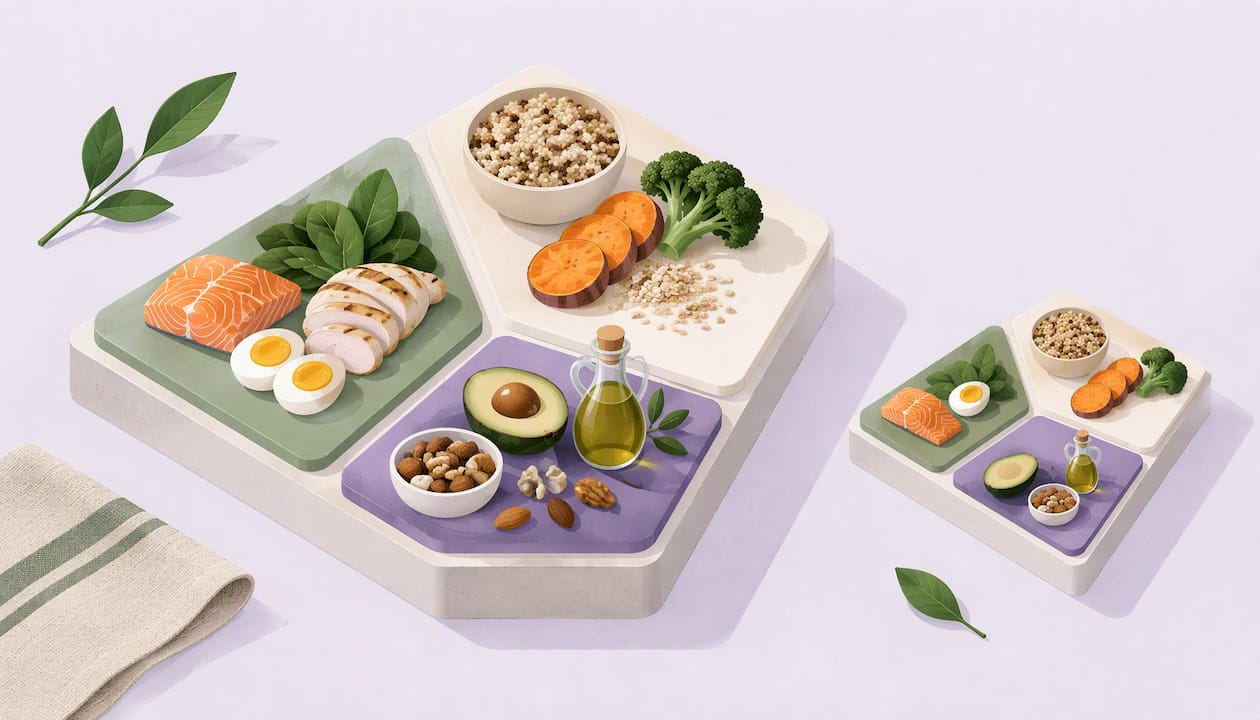
The best macro split for muscle gain is the one built from your body weight, not from a fixed percentage. Start with protein at about 1.6 to 2.2 g per kg (0.7 to 1.0 g per lb), keep fat moderate, let carbs fill the rest of your calories, and eat a small, steady surplus. For many lifters that lands near 50 to 60% carbs, 15 to 25% protein and 20 to 30% fat, but the grams matter more than the ratio.
If you have seen a dozen different answers (40/40/20, 50/25/25, 35/35/30), you are not imagining it. They are all rough descriptions of the same idea. Below, you will see why percentages can mislead, how to calculate your own numbers step by step, and how to track them without it taking over your day.
Log meals by photo, voice, text, barcode or manual entry, then compare your calories and macros with your daily goal.
Get the AppTL;DR
- Calories drive weight gain; protein drives how much of it is muscle. The exact ratio is a supporting tool.
- Set protein at 1.6 to 2.2 g/kg and fat at 0.5 to 1.5 g/kg, then fill the remaining calories with carbs.
- Use a modest surplus: roughly 5 to 10% if you are experienced, up to 10 to 20% if you are new to lifting.
- Spread protein across 3 to 6 meals, and adjust every 2 to 3 weeks based on your weight trend and your lifts.
Why percentages alone can mislead you
Most articles give you a ratio such as 40% carbs, 30% protein, 30% fat. It is easy to remember, and it is a fine starting sketch. The problem is that a percentage depends on your total calories, and total calories differ a lot from person to person.
The narrative review of off-season bodybuilding nutrition points out that a lighter, very active person who follows a strict percentage goal can end up eating more protein than they need. That leaves too little room for the carbs that fuel training. Setting protein and fat by body weight first, then filling the rest with carbs, is the more precise route.
Older research shows how much ratios vary. One review of macronutrient intake in bodybuilding suggested roughly 55 to 60% carbohydrate, 25 to 30% protein and 15 to 20% fat. Pages ranking today suggest different splits again. None of them is wrong for everyone, which tells you the ratio is not the main lever.
The main levers are these:
- Energy balance. You need to eat more than you burn to build tissue.
- Enough protein. This is what gives the surplus somewhere useful to go.
- Training. Without progressive resistance training, no macro split builds muscle.
The split then helps with training quality, recovery and how full you feel.
The numbers to aim for, macro by macro
Protein: 1.6 to 2.2 g per kg
The off-season nutrition review supports a daily protein intake of about 1.6 to 2.2 g per kg of body weight for muscle growth. Eating more than 2.2 g/kg gives no additional benefit for muscle mass and can crowd out carbs.
In pounds, that is roughly 0.7 to 1.0 g per lb. If you want a quick sense of scale, one palm-sized portion of cooked chicken, fish or tofu is a useful visual anchor for a single serving. Most people need several of those across the day.
The International Society of Sports Nutrition position stand on protein is another good reference if you want to read the underlying evidence yourself.
Fat: 0.5 to 1.5 g per kg
The same review puts fat at 0.5 to 1.5 g/kg per day, or about 20 to 35% of calories. Fat supports hormone health, and very low-fat diets are generally discouraged because they may lower androgen levels. On the other side, a lot of fat leaves less room for the carbs you need to train hard.
A practical middle: about 1 g/kg, then adjust by preference. If you love rice and pasta, sit lower in the range. If you prefer nuts, eggs and olive oil, sit higher and eat slightly fewer carbs.
Carbs: fill the rest, at least 3 to 5 g per kg
Once protein and fat are set, the remaining calories go to carbohydrates. The review recommends at least 3 to 5 g/kg per day to support resistance training and replenish glycogen, and it notes that needs rise and fall with training volume and intensity. Carbs are the flexible macro: on a heavy leg day you may want more, on a rest day a little less.
A quick comparison of common splits
| Split (carbs/protein/fat) | Who it tends to suit | Watch out for |
|---|---|---|
| 50/25/25 | Moderate calories, balanced eaters | Protein may be high if you are light and eating little |
| 40/40/20 | Anyone eating fewer calories or leaning out | Carbs may be too low for hard training volume |
| 35/35/30 | Those who prefer higher-fat foods | Little room for carbs, which can hurt training |
| 55/20/25 | Larger lifters eating 3,000+ calories | Check that protein still reaches 1.6 g/kg |
Treat the table as a sanity check, not a recipe. If your grams per kg are right, your percentages will fall into place by themselves.
How big should your surplus be?
Muscle needs extra energy, but more is not better. A review on the energy surplus for hypertrophy suggests advanced trainees should be more conservative, around a 5 to 10% surplus, to limit fat gain. Beginners can benefit from a larger one, about 10 to 20%.
A useful reality check is the scale. A steady gain of roughly 0.25 to 0.5% of body weight per week is a more reliable sign of lean growth than an aggressive surplus. For an 80 kg person, that is about 200 to 400 g per week. If you are gaining faster, you are probably adding more fat than you need to.
To find your starting calories, estimate your maintenance first. Our TDEE and nutrition calculators can give you a starting estimate, which you then add your surplus to. It is an estimate, so your real maintenance may differ. Your weight trend over two to three weeks is the truth.
A worked example: 80 kg lifter, moderate surplus
Let’s build a split from scratch. The inputs below are an example, not a prescription.
Assumptions: body weight 80 kg (176 lb), estimated maintenance 2,800 kcal, a 10% surplus.
- Calories: 2,800 + 10% = 3,080 kcal.
- Protein: 1.8 g/kg × 80 = 144 g. At 4 kcal per gram, that is 576 kcal.
- Fat: 1 g/kg × 80 = 80 g. At 9 kcal per gram, that is 720 kcal.
- Carbs: 3,080 − 576 − 720 = 1,784 kcal. At 4 kcal per gram, that is about 446 g, or roughly 5.6 g/kg.
As percentages, that comes out near 58% carbs, 19% protein and 23% fat. Notice that this does not match any of the popular splits exactly, and it does not need to. Protein is in the evidence-based range, fat is moderate, and carbs sit above the 3 to 5 g/kg floor to fuel training.
If you prefer to skip the arithmetic, our macro calculator gives daily protein, carbs and fat in grams, and the protein target calculator focuses on the first number. For the full method, see our guide on how to calculate accurate macros.
Spread protein through the day
Total daily protein comes first, but distribution helps. The off-season review notes that spreading protein over 3 to 6 meals, each providing about 0.40 to 0.55 g/kg, is more effective for muscle protein synthesis than loading one or two big meals. A small trial in healthy young men looked at protein spread evenly across three meals and resistance training, and it is worth a read if you like the detail.
For our 80 kg example, 0.4 to 0.55 g/kg means about 32 to 44 g of protein per meal. Four meals at 36 g gets you to 144 g.
Two habits make this easier:
- Do not skip a protein-rich breakfast. It is a common gap, since many people save most of their protein for dinner.
- Have a protein-rich meal 1 to 2 hours before or after training. The review also suggests a slow-digesting protein source 1 to 2 hours before sleep to support recovery overnight.
Nutrient timing is secondary to your daily total, so do not stress about the exact minute you eat.
What to do when the scale stalls
Adjust one thing at a time, and wait two to three weeks before judging a change.
- Weight not moving and lifts flat: add 100 to 200 kcal, mostly from carbs.
- Gaining faster than about 0.5% of body weight per week: trim 100 to 200 kcal, again mostly from carbs.
- Strength rising but weight flat: that can be a good sign, especially for newer lifters. Keep going and check again.
- Feeling flat in the gym: check whether your carbs have crept below your training needs.
- Always hungry: raise protein slightly within the range, or add high-volume carbs such as potatoes, oats and fruit.
If you have a medical condition, such as kidney disease or diabetes, or you are pregnant, talk with a doctor or registered dietitian before changing your protein or carb intake.
Our perspective: precision beats perfection
We build a calorie and macro tracker, so we see the same pattern in how people approach bulking. They pick a ratio, feel unsure, then give up on logging after a week or two because it feels like homework. Our view is that the best macro plan is the one you can follow on a Tuesday night when you are tired.
That is why we think in grams, with protein as the anchor. You log a meal with a photo, a voice note, text, a barcode or a manual entry, and Cibo shows calories, protein, carbs and fat based on USDA FoodData Central, along with your daily balance against a personal goal. You do not need a spreadsheet to find out you are 30 g short of protein at 8 p.m.
We also think trends matter more than any single day. One high-carb Saturday will not undo anything, and one low day will not ruin a week. Look at your weekly average and your training log, and change one variable at a time.
And if you train with a partner or friend, accountability helps. Seeing each other’s progress and sending encouragement turns tracking into something you do together.
Make tracking easier
A split on paper only works if you can measure what you eat. Cibo has a 7-day trial, then subscription. You can log by photo, voice, text, barcode or manual entry, and track side by side with a partner or friends in Together mode. Cibo Pro is $39.99 per year, with monthly options available in the app stores. See the plan details to compare.
Making your macros fit real life
A few practical tips to hit your targets without eating the same plate every day:
- Prep the base, vary the rest. Cook a big batch of rice or potatoes and a protein, then change sauces and sides. This lunch meal prep formula is a handy starting point.
- Pick your hardest macro first. For most lifters it is protein. Build each meal around it.
- Plan restaurant meals. Most menus have a grilled protein and a starch. Our guide to macro-friendly restaurant orders shows how to log them.
- Weigh occasionally, not always. Check portions on a scale for a couple of weeks to calibrate your eye, then rely on estimates.
- Keep a 5 to 10 g margin. Hitting within a few grams is fine. Obsessing over single digits is not worth the stress.
If your goal later shifts to losing fat, the logic stays the same, with a deficit instead of a surplus. Our guide to macros for fat loss walks through it.
FAQ
What should my macro split be for muscle gain?
Set protein at 1.6 to 2.2 g per kg, fat at 0.5 to 1.5 g per kg, and fill the rest with carbs, at least 3 to 5 g per kg. For many people this ends up around 50 to 60% carbs, 15 to 25% protein and 20 to 30% fat. Use the grams as your real target.
Is a 40/40/20 macro split good for building muscle?
It can work if your calories are modest, because 40% protein is plenty. The risk is that only 40% carbs may leave you short on fuel for hard training at higher calorie levels. Check your grams per kg before you commit to it.
Do I need a different split for bulking than for lean gains?
Not really. The split stays similar and the main difference is the surplus size. Experienced lifters generally do better with a smaller surplus of about 5 to 10%, while beginners can use a bit more.
Is more than 2.2 g of protein per kg better?
The research reviewed here finds no additional muscle benefit above about 2.2 g/kg. Extra protein can also take up calories that carbs would use to fuel your training. If you have kidney or other medical concerns, check your protein target with a doctor or dietitian.
Sources
- Nutrition Recommendations for Bodybuilders in the Off-Season: A Narrative Review
- Macronutrient considerations for the sport of bodybuilding
- Magnitude and Composition of the Energy Surplus for Maximizing Muscle Hypertrophy
- International Society of Sports Nutrition Position Stand: protein and exercise
- Evenly Distributed Protein Intake over 3 Meals and Muscle Hypertrophy in Healthy Young Men
Recommended
Not medical advice. Cibo is a nutrition-awareness tool, not a medical device. Read the full disclaimer.
Build healthier habits with Cibo
Nutrition made simpler for everyday life.


