
How to Analyze Your Eating Patterns in 7 Days
Learn how to analyze your eating patterns: what to log, how long to track, how to read your food diary for habits, and how to adjust with small steps.
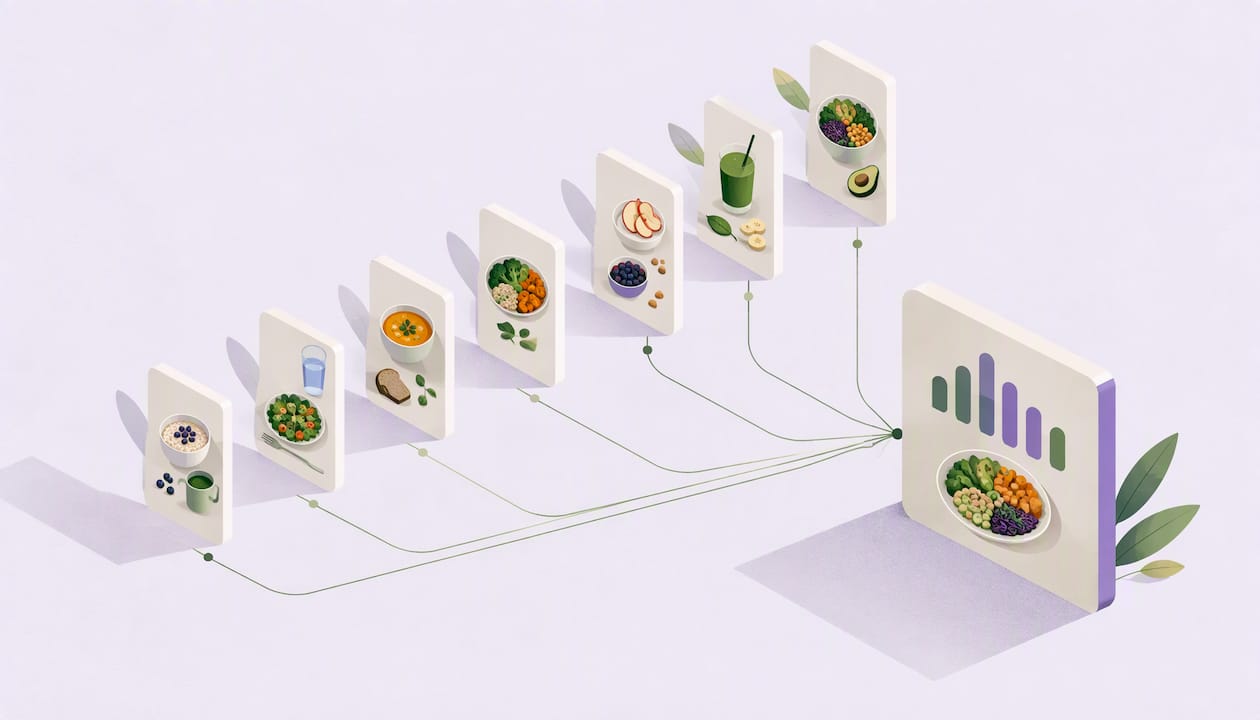
To analyze your eating patterns, write down what you eat, how much, when, where, and how you feel for one week. Then read the log back and look for repeats: meals you skip, late-night snacking, a lunch that always runs short on protein. The goal is not a perfect diary. It is a clear picture of what you actually do, so you can change one or two things on purpose.
This guide gives you the exact method: what to record, how long to keep going, how to read the results, and what to do next. It works whether you want to lose around 10 kg, build muscle, or just stop guessing.
Log meals by photo, voice, text, barcode or manual entry, then review calories and macros against your personal goal.
Get the AppTL;DR
- An eating pattern is more than a list of foods. It covers timing, content, and context: when, what, and where and with whom you eat.
- Track for about one week, logging right after you eat so the record stays accurate.
- Review the log for repeats, then pick no more than two or three small changes.
- Tracking is a tool for insight, not for guilt. If you have a medical condition, bring your log to a doctor or registered dietitian.
What it means to analyze your eating patterns
Most people think of a diet as a list of foods. Researchers look wider. In nutrition science, meal patterns are examined along three dimensions: temporal (timing and distribution), content (food combinations), and context (location, activities while eating, and who is present). Another review describes the same idea as patterning, format, and context: how often and how regularly you eat, what the meal contains, and the setting around it.
That is useful for you because the three dimensions explain different problems:
- Timing: You skip breakfast, eat a huge dinner, and snack at 11 p.m.
- Content: Your meals are heavy on refined carbs and light on protein or vegetables.
- Context: You eat at your desk, in front of the TV, or only when stressed.
Health agencies describe the practical version simply. Analyzing your eating means tracking what, when, where, and why you eat, then reflecting on which habits you want to change and which you want to keep.
What to track
You do not need to record everything about your life. Start with these six items. MedlinePlus recommends noting what you eat, how much, the time of day, what else you were doing, and how you were feeling.
- The food or drink. Include sauces, oils, and drinks. They are the items people forget most.
- The amount. Grams, cups, or a visual anchor. A palm is roughly one protein serving, and a deck of cards is roughly 3 oz of meat.
- The time. Even to the nearest 15 minutes is enough.
- The place. Home, desk, car, restaurant, couch.
- What else you were doing. Working, scrolling, watching TV, talking with family.
- How you felt. Hungry, bored, stressed, tired, happy. One word is plenty.
The context items matter more than they look. Research summarized for physicians notes that regular family meals are associated with healthier intake in children and parents, while watching television during meals is inversely associated with diet quality. Feelings matter too: food journaling can reveal links between eating and emotions such as stress.
Add numbers if your goal needs them
If you are cutting weight or building muscle, add calories, protein, carbs, and fat to the six items above. The numbers should come from a reliable reference. USDA FoodData Central is the U.S. government’s food composition database, and it is the standard to log against. If you want a quick way to look up a food, our walkthrough on finding food calories with USDA data shows how.
Not sure what your daily targets should be? A macro calculator gives you a starting point in grams of protein, carbs, and fat, which you can adjust after you see your real patterns.
How long to track
One week is the sweet spot for a first look. MedlinePlus suggests you keep a food journal for one week, then review your eating patterns and decide which habits to change.
A week works because it includes both workdays and weekend days, and most people eat differently on each. If your schedule is irregular, such as shift work or travel, extend to two weeks so you see more than one version of your routine.
Two tips make the week count:
- Log right after you eat. A food journal is more accurate when you record food and drinks right after eating. Memory at 9 p.m. is unreliable for a 1 p.m. lunch.
- Do not change how you eat to look good in the log. A messy but honest week is far more useful than a tidy fake one.
The 7-day method, step by step
- Day 0: choose your tool. A notebook, a notes app, a spreadsheet, or a calorie tracker all work. Pick whichever you will actually use at every meal. The best method is the one you do not skip.
- Days 1 to 7: log as you go. Record the six items from above. If you forget a meal, write down your best estimate rather than leaving a gap.
- Day 7 evening: take a short break. Do not analyze in the middle of the week. You will start changing things too early.
- Day 8: review in one sitting. Set aside 20 to 30 minutes and go through the questions in the next section.
- Day 8: choose two or three changes. Write them down in plain words.
- Week 2 onward: test and recheck. Keep logging loosely, or repeat a one-week check every month or two.
What if you cannot weigh food?
Weighing every portion is the most common reason people quit. You do not have to. Estimates based on hand portions and photos are good enough to see patterns, and our guide on counting calories without weighing food explains how to keep estimates reasonably consistent.
How to read your log: 8 questions to ask
After a week, you have a pile of data. Here is how to turn it into patterns. Go through your log with a highlighter, or just a few notes, and answer each question.
Timing questions
- How many times a day do you actually eat, and how regular is it? Count meals and snacks per day. Look for days that break your usual rhythm. In one review of meal pattern research, a three-meals-a-day pattern was associated with higher diet quality than breakfast skipping or grazing patterns. That does not mean everyone must eat three meals, but it is worth noticing if you graze all day or skip the first meal and then overeat in the evening.
- Where does most of your intake land? Many people find that 60 percent or more of their food comes after 6 p.m. If so, daytime meals may be too small, which makes the evening hard to control.
- Are there long gaps? A seven-hour stretch without food, followed by a big meal, is a common setup for overeating.
If you are experimenting with long fasting windows, read up on intermittent fasting and bone density before making it a daily routine.
Content questions
- Is protein spread across the day, or crammed into dinner? For gym-goers and people losing weight, this is often the biggest finding. Breakfast and lunch are frequently low in protein.
- How many servings of vegetables, fruit, whole grains, and legumes do you get? The 2025 Dietary Guidelines Advisory Committee found that patterns linked with favorable health outcomes generally included more vegetables, fruits, legumes, and nuts, and most also included more whole grains and fish or seafood. Compare your week to that list.
- Which items are limited by the CDC, and how often do they appear? The CDC advises that highly processed foods, added sugars, added sodium, and refined carbohydrates should be limited. Count the appearances, including drinks. Our note on tracking alcohol calories is helpful if drinks add up on weekends.
Context questions
- Where and with what distraction do you eat the most? Mark every meal eaten in front of a screen or while working. Then compare the portions with meals eaten at a table.
- What feelings show up before your least planned eating? Stress, boredom, and tiredness are the usual suspects. Write the feeling next to the food, and the link often becomes obvious.
Common eating patterns you might spot
A university nutrition text groups eating patterns into overeating, restrictive, and instinctive eating, and notes that people may cycle between them. Your log may fit one of these:
| Pattern | What it looks like in a log | A small first step |
|---|---|---|
| Restrictive | Skipped or tiny meals early, a big meal late | Add a protein-rich breakfast or lunch |
| Overeating | Large portions, eating until uncomfortable, often tied to stress | Plate food instead of eating from the package; note the feeling |
| Grazing | Many small intakes, no clear meals | Set two or three planned eating times |
| Instinctive | Eating when hungry, stopping when satisfied | Keep doing it; protect it on busy days |
The same source describes instinctive eating, which means eating for fuel when you are hungry and doing it mindfully, as a positive relationship with food worth striving for. You may find you cycle: restrictive on weekdays, overeating on weekends. Seeing that cycle on paper is often the first time it clicks.
What a healthy pattern looks like
There is no single correct diet. The WHO states that healthy diets come in many forms, built on adequacy, balance, moderation, and diversity, and that what is healthy varies with age, gender, lifestyle, activity, culture, and local foods. A Harvard Health summary of the U.S. guidelines adds that U.S.-style, Mediterranean-style, and vegetarian patterns differ in composition but all include many vegetables and fruits.
So use your log to ask, “Is this pattern balanced, varied, and workable for my life?” rather than “Is this the perfect diet?”
One more finding helps with expectations. For weight, adherence is more closely associated with weight loss after one year than the specific diet pattern. The pattern you can stick with beats the pattern that looks best on paper.
Turning insights into small changes
This is where most people go wrong: they find six problems and try to fix them on Monday. MedlinePlus suggests focusing on small steps, such as keeping healthy snacks at work, planning meals, or replacing cookies with fruit, and limiting yourself to no more than two or three goals at a time.
The American Heart Association adds that after you identify barriers in your diary, you should start small and focus on ways to overcome them.
Here is how that looks with real findings:
- Finding: Lunch is a skipped meal on three workdays. Change: Pack one fixed lunch on Monday and Wednesday.
- Finding: Protein is mostly at dinner. Change: Add one protein source to breakfast, such as eggs or yogurt.
- Finding: Evening snacking happens in front of the TV. Change: Portion the snack into a bowl and eat it at the table.
- Finding: You eat out often and have no idea how it fits your targets. Change: Learn a few macro-friendly restaurant orders and log them the same day.
- Finding: Fiber is low and digestion is inconsistent. Change: Try a two-week fiber tracking routine and see what changes.
The evidence for keeping a record is encouraging, though not a guarantee. The American Heart Association notes that some research shows people who kept food records had greater weight loss success than people who did not. Individual results vary, and no outcome is promised by tracking alone.
Make logging easier with an app
The hard part of any food diary is the daily effort. If a notebook feels like homework, a tracker that does the arithmetic for you can help you reach the review stage.
Cibo lets you log a meal by photo, voice, text, barcode, or manual entry, then shows calories, protein, carbs, and fat based on USDA FoodData Central, along with your daily balance against a personal goal. Its Together mode lets a partner or friend follow your progress, which is handy if your eating context includes shared meals and you want accountability without nagging. Cibo is available on iOS and Android and starts with a 7-day trial, then subscription: Cibo Premium is $39.99 per year, or $6.99 per month on iOS and $4.99 per month on Android. You can also look at the Together page to see how shared tracking works.
Perspective: why we think patterns beat single meals
We see the same thing again and again in how people use a food log: the single meal almost never matters. A pizza night is not the problem. The pattern around it is: the skipped lunch that made it a 9 p.m. meal, the stressful week that made it a habit, the missing protein earlier in the day. That is why we built our approach around quick, low-friction logging. If recording a meal takes five seconds, you log all of them, including the ones you would rather not see, and honest data is what makes the review useful.
We also believe tracking should feel supportive. A number is information, not a verdict. Use it the way you would use a map: to see where you are, then decide where to go next, ideally with one or two small steps rather than a total overhaul. Sharing the journey with a partner or friend makes those steps easier to keep.
When tracking is not enough
Food logs have limits. They depend on honest, complete entries, and portions are often estimated. They can also become stressful for some people. The Canadian HealthLink BC guidance is direct: food journaling is not about judging yourself or feeling guilty or ashamed. If counting and logging starts to cause anxiety, or you notice you are restricting heavily or bingeing, stop tracking and talk with a doctor or registered dietitian.
There is also a medical side. Roughly 60 percent of U.S. adults have one or more diet-related chronic diagnoses, including cardiovascular disease, diabetes, and obesity. If you have one of these conditions, are pregnant, take medications that interact with food, or have high metabolic demands, interdisciplinary nutrition care is the right route. Bring your one-week log to the appointment. It gives the professional a real picture instead of a guess.
FAQ
What is a healthy eating pattern?
It is a pattern built on balance, variety, and moderation rather than a single rigid diet. Official guidance points to plenty of vegetables, fruits, legumes, nuts, and whole grains, with highly processed foods, added sugars, and excess sodium limited. What works best also depends on your age, activity, culture, and the foods available to you.
How long should I track my food to see patterns?
One week is a good start, and MedlinePlus recommends exactly that. Make sure the week includes weekend days. If your schedule changes a lot, track for two weeks so you capture different routines.
What is the 3-3-3 rule of eating?
There is no standard official 3-3-3 rule, and different websites use the phrase for different ideas, so check what a source means before following it. A more reliable approach is to track your own week and notice how many times a day you eat and how regular your meals are.
How do I adjust my eating habits once I see the patterns?
Pick no more than two or three small changes, such as adding protein to breakfast, planning lunches, or eating snacks at the table. Try them for a couple of weeks, then check your log again. Small, repeatable steps are easier to keep than a full overhaul.
Do I need to count calories to analyze my eating patterns?
No. Timing, context, and food variety already tell you a lot. Add calories and macros if your goal, such as weight loss or muscle gain, depends on specific numbers, and use USDA FoodData Central values for accuracy.
Sources
- Food journaling: How to keep track of what you eat (HealthLink BC)
- Meal Pattern Analysis in Nutritional Science (PMC)
- Understanding meal patterns: definitions, methodology and impact (PMC)
- Eating habits and behaviors (MedlinePlus)
- Nutrition History Taking: A Practical Approach (AFP)
- Food Journaling: What it is, Benefits & Tips (Cleveland Clinic)
- Scientific Report of the 2025 Dietary Guidelines Advisory Committee
- Healthy Eating Tips (CDC)
- Reflecting On Common Eating Patterns (University of Minnesota)
- Healthy diet (WHO)
- How the Dietary Guidelines define a healthy eating pattern (Harvard Health)
- Keeping a Food Diary (American Heart Association)
- Intermittent Fasting and Bone Density
Recommended
Not medical advice. Cibo is a nutrition-awareness tool, not a medical device. Read the full disclaimer.
Build healthier habits with Cibo
Nutrition made simpler for everyday life.


