
Manual Food Logging: How to Do It Fast and Accurately
Manual food logging works when you keep it simple. Learn what to record, how to estimate portions, and when automatic tracking saves you time.
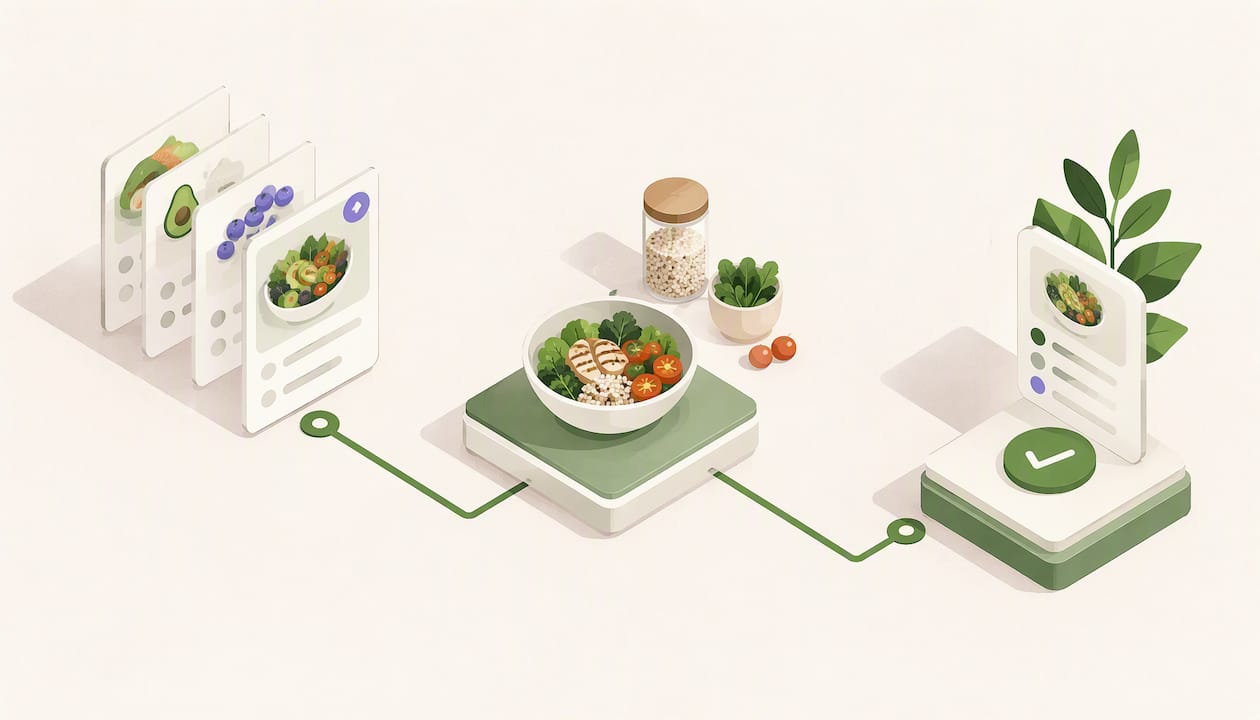
Manual food logging means you write down or type in what you eat yourself, meal by meal, instead of letting an app guess from a photo. It works well when you keep the routine small: record each meal right after you eat, note the amount, and accept that a close estimate beats a perfect entry you never finish. Below you will find what to record, how to estimate portions without a scale, how to handle raw versus cooked food, and how manual tracking compares with automatic tracking.
Cibo lets you log meals by text, voice, photo, barcode or manual entry, then track calories and macros against a personal goal.
Get the appTL;DR
- Log each meal right after eating, with the food, how it was prepared, the amount and the time.
- Estimate portions with your hand when you have no scale, and stay consistent so your numbers are comparable from day to day.
- Log food in the state you weighed it: raw weight with a raw entry, cooked weight with a cooked entry.
- Research does not crown a single winner between manual and photo-based tracking, so pick the method you will actually keep using.
- Start with calories, add protein next, and treat your target as a starting point you adjust.
What manual food logging really is
Manual logging covers a wide range. At the simple end, it is a paper notebook or a notes app where you list what you ate. At the detailed end, it is searching a food database, picking the right entry, setting a serving size and saving it, for every item in every meal.
The common thread is that you do the work of identifying the food and the amount. That gives you control. You decide whether the oil in the pan counts, whether that was a large or medium banana, and whether the sauce goes in. It also costs you time, and that is where most people quit.
If you have ever felt worn out by adding item after item and repeating it for every meal, you are in good company. Reader threads about manual calorie logging are full of people who tracked homemade dinners for a week and then stopped. The fix is rarely more discipline. It is a lighter routine.
How to start a food journal
You do not need a special system on day one. Public health guidance describes the basic habit as tracking when, what and how much you eat and drink each day. The same guidance suggests recording right after you eat and measuring portions where you can, since memory fades fast.
What to write down for each meal
A useful entry has five parts:
- The specific food or drink. “Yogurt” is vague. “Plain low-fat yogurt” is better.
- How it was prepared. Grilled, fried, baked or raw changes the numbers.
- Sauces, condiments, dressings and toppings. Harvard Health lists these explicitly as part of a good food diary, and they are the items people forget most often.
- The amount. Grams, cups, pieces or a hand-based estimate.
- The time. It helps you spot patterns, such as late-afternoon snacking.
How detailed should you go?
That depends on your goal. The Cleveland Clinic notes that food journals range from simple records of foods, drinks, timing and amounts to more detailed tracking of hunger, fullness, surroundings, thoughts and feelings. If you want to understand why you eat, not just what, a mindful eating guide shows how to add the experience of the meal to your notes.
If your goal is a calorie or protein target, stay at the simple end. You can always add detail later.
A one-week starter plan
- Days 1 to 2: Log one meal a day, whichever is easiest. No measuring.
- Days 3 to 4: Log two meals a day and add rough amounts.
- Days 5 to 7: Log everything, including drinks and snacks, using hand estimates.
The Cleveland Clinic’s advice matches this pacing: start slowly, record one meal at a time and do not worry about exact measurements at first.
Estimating portions without a scale
A kitchen scale is the most reliable tool for manual logging. But you will eat at restaurants, at friends’ houses and at your desk, and a scale will not always be there. Your hand is always with you.
A common hand-portion method uses your palm for protein, your fist for vegetables, your cupped hand for carbohydrates and your thumb for fats. It gives approximate calorie and macro amounts, not exact ones, but it is consistent, and consistency matters more than precision when you are looking at trends.
A few visual anchors help too:
- A palm-sized piece of chicken, fish or tofu is roughly one protein serving.
- A deck of cards is about 3 oz of cooked meat.
- A cupped handful of rice or pasta is roughly one carbohydrate serving.
- A thumb-sized amount of oil, butter or nut butter is one fat serving.
These are rules of thumb. People are different sizes, and your hand scales with you. The British Nutrition Foundation points out that portion sizes vary by person: taller or very active adults may need more, while smaller people or those trying to lose weight may need less.
Using packaged-food labels
For packaged food, the Nutrition Facts label is your friend. The serving size printed on it is regulated by the FDA, so it reflects a standardized amount. The catch is that the serving on the label is not always what you ate. If the label says one serving is half a cup and you poured a full cup, you log two servings.
For whole foods without labels, look up the item in USDA FoodData Central, the government’s nutrient database. Our step-by-step guide to finding food calories with USDA data walks through how to pick the right entry.
Raw or cooked: which do you log?
This is one of the most common questions in manual logging, and the answer is simple: log the food in the state you weighed it.
Cooking changes water content. Chicken, rice, pasta and vegetables all gain or lose water as they cook, so the nutrients per 100 grams change even though the total calories in the pan do not. That means:
- If you weigh chicken raw, pick a raw entry.
- If you weigh it after cooking, pick a cooked entry.
- Never weigh cooked food and log it against a raw entry, or the reverse. You will be off by a meaningful margin.
For rice and pasta, a cooked entry is usually easier, since you portion them after cooking. For meat you buy by weight and cook in batches, raw weighing at the start of meal prep is fine, as long as you log it raw.
One more tip: when you cook with oil, butter or sauce, add those as separate lines. They are small in volume and large in calories.
Why manual tracking is hard to keep up
There are three typical friction points.
Searching. Databases often contain several entries for the same food, with different numbers. Picking among them takes time and invites errors.
Mixed dishes. A homemade curry or a restaurant bowl has many ingredients. Logging each one is slow, and skipping them makes the entry vague.
Fatigue. Logging is a daily task with no end date. Even motivated people get tired of it.
An approach that helps with all three is to save your repeat meals. Most people eat the same ten to fifteen breakfasts and lunches on rotation. Once those are logged accurately, the rest of the week takes a fraction of the time.
For days when you cannot measure anything, we like the idea of getting close without a scale. Our guide on counting calories without weighing food covers practical shortcuts, and the one on tracking calories without a database shows a workflow that skips most of the searching.
Manual vs automatic calorie tracking
“Automatic” usually means photo, voice or barcode logging, where software identifies the food and estimates the amount. Here is how the two compare on what matters day to day.
| Criteria | Manual entry | Automatic (photo, voice, barcode) |
|---|---|---|
| Time per meal | Longer, especially for mixed dishes | Seconds for most meals |
| Control over each ingredient | High | Lower, though you can usually edit |
| Best for | Single foods, weighed portions, recipes you know well | Restaurant meals, quick snacks, busy days |
| Typical weak spot | Fatigue and database mistakes | Hidden ingredients and portion size |
| Learning curve | Low, but repetitive | Low |
What the research says about accuracy
The honest answer is that neither method wins across the board.
A 2026 meta-analysis found that photo-based dietary assessment may outperform manual entry when the pipeline is well trained and the meals suit it, but the literature does not support a category-level ranking. Mixed-dish meals, in particular, favored manual entry. The authors also say that the variation between studies is itself a finding.
Manual apps are not error-proof either. An Australian study that tested 16 manual food-logging apps found that 14 overestimated energy for Western diets and 13 underestimated it for Asian diets, with mean differences of 1040 kJ and minus 1520 kJ respectively. Researchers there argue that working with dietitians to refine databases would improve the credibility of these tools across different cuisines.
AI estimates have their own error range. A 2023 systematic review reported relative calorie errors between AI and ground truth from 0.10% to 38.3%, and concluded that AI performance currently aligns with human estimation capabilities.
What you can take from this:
- Every method has error. Manual does not mean exact.
- Your database entry matters as much as your portion. A wrong entry skews the result no matter how carefully you measure.
- Mixed dishes are the hard case for any method.
- A method you keep using beats a more precise one you drop.
A practical hybrid
Many people do best with a mix. Weigh and log manually at home, where it is easy and you know the ingredients. Use photo, voice or barcode logging when you are out, rushed or eating something packaged. Then check the entry for obvious mistakes, such as a missing sauce or the wrong serving size.
Barcodes are fast but not flawless. If you scan a lot of packaged food, our guide to fixing barcode scans explains common problems and why calories tend to be the more dependable number.
Making a food log support your goal
A log is a tool, not a test. The Cleveland Clinic notes that a food journal can help with weight management by revealing eating habits and patterns, and that exact measurements are not required.
If you want to lose weight
Use the log to find patterns before you change anything. Look at your first week and ask:
- Which meal is largest?
- Where do snacks and drinks add up?
- Do weekends look different from weekdays?
Then change one thing at a time. Weight changes vary from person to person, so we do not promise any particular amount or pace. If you have a medical condition, are pregnant, or have a history of disordered eating, talk with your doctor or a registered dietitian before you start tracking.
If you want to build muscle
The log’s main job is to check your protein and overall intake. Weigh protein sources when you can, since a palm estimate can be off for a large cut of meat. A scale reading alone will not tell you what is changing, though. Pair your food log with training notes, and see this piece on whether you are gaining muscle or fat for what the scale misses.
Start with calories, then add protein
Tracking everything at once is a common reason people quit. Our article on calories versus macros recommends starting with calories and adding protein next. If you want a gram target for protein, carbs and fat, the macro calculator gives you a starting point.
Treat any target as a pencil mark. Adjust it after two or three weeks of consistent logging, based on how you feel, how you train and how your weight trend moves.
Our perspective: precision you can sustain
We build tracking tools, and what we see again and again is that people do not fail because they are lazy. They fail because the routine asks for too much. A food log that takes ten minutes a meal will not survive a busy week.
So we think about precision as a budget. Spend it where it matters: weigh the foods that make up most of your calories and protein, such as meat, rice, oils and nut butter, and estimate the rest. A cup of lettuce does not need a gram scale.
We also think the manual versus automatic debate is framed too narrowly. The research shows mixed results, and mixed dishes can favor manual entry, so we would not tell anyone to give up control entirely. But we would not ask anyone to type out every ingredient of every meal forever either. Use whichever method gets the entry done in the moment, then correct it if something looks off.
Finally, accountability helps. Logging with a partner or a friend makes the habit feel shared, and a short message of encouragement on a hard day often does more than another rule.
A faster way to log, when you want one
If manual entry is wearing you down, Cibo lets you log a meal by photo, voice, text, barcode or manual entry. You get calories, protein, carbs and fat based on USDA FoodData Central, plus your daily balance against a personal goal. You can still edit anything, so you keep control when it matters.
It is available for iOS and Android, with a 7-day trial, then subscription. Premium costs $39.99 per year on both platforms, or monthly at $6.99 on iOS and $4.99 on Android. Together mode lets you track with a partner or friends, and the full plan details are on our site.
FAQ
Is manual food logging accurate?
It can be, but it depends on the database entry and your portion estimate more than on the method. One study of 16 manual apps found consistent over- or underestimates of energy depending on the type of diet. Weighing key foods and choosing entries carefully gets you closer.
How do I start a food journal?
Start with one meal a day and write down what you ate, how it was prepared, the amount and the time. Add sauces and drinks, since they are easy to forget. Build up to all meals over a week.
Should I log food raw or cooked?
Log it in the state you weighed it. If you weighed it raw, use a raw entry. If you weighed it cooked, use a cooked entry, because cooking changes water content and the nutrients per 100 grams.
Is manual or automatic tracking better?
Neither is better in every situation. Research finds photo-based methods can do well on suitable meals, while mixed dishes often favor manual entry. Many people use manual entry at home and automatic logging on the go.
How long do I need to log my food?
There is no fixed answer. Many people log for a few weeks to learn typical portions and patterns, then switch to lighter check-ins. If you have a medical condition or a history of disordered eating, ask your doctor or dietitian what is right for you.
Sources
- Food journaling: How to keep track of what you eat (HealthLink BC)
- Why keep a food diary? (Harvard Health)
- Food Journaling: What it is, Benefits & Tips (Cleveland Clinic)
- How to Do Hand Portion Math to Track Your Macros (Precision Nutrition)
- Lesson 2: How Does Your Food Measure Up? (UC Davis)
- Your balanced diet (British Nutrition Foundation)
- Photo-based vs. manual-entry dietary assessment: a meta-analysis (2026)
- Evaluating the Quality and Comparative Validity of Manual Food-Logging Apps (Nutrients, 2024)
- AI-Based Digital Image Dietary Assessment Methods Compared (Merrimack College, 2023)
- Your Complete Guide to Mindful Eating
- Am I gaining muscle or fat?
Recommended
Not medical advice. Cibo is a nutrition-awareness tool, not a medical device. Read the full disclaimer.
Build healthier habits with Cibo
Nutrition made simpler for everyday life.


