
Plate Method Macros: Build Balanced Meals Without a Scale
See how the plate method maps to protein, carbs and fat, how to adjust it for fat loss or muscle gain, and when to start tracking grams for precision.
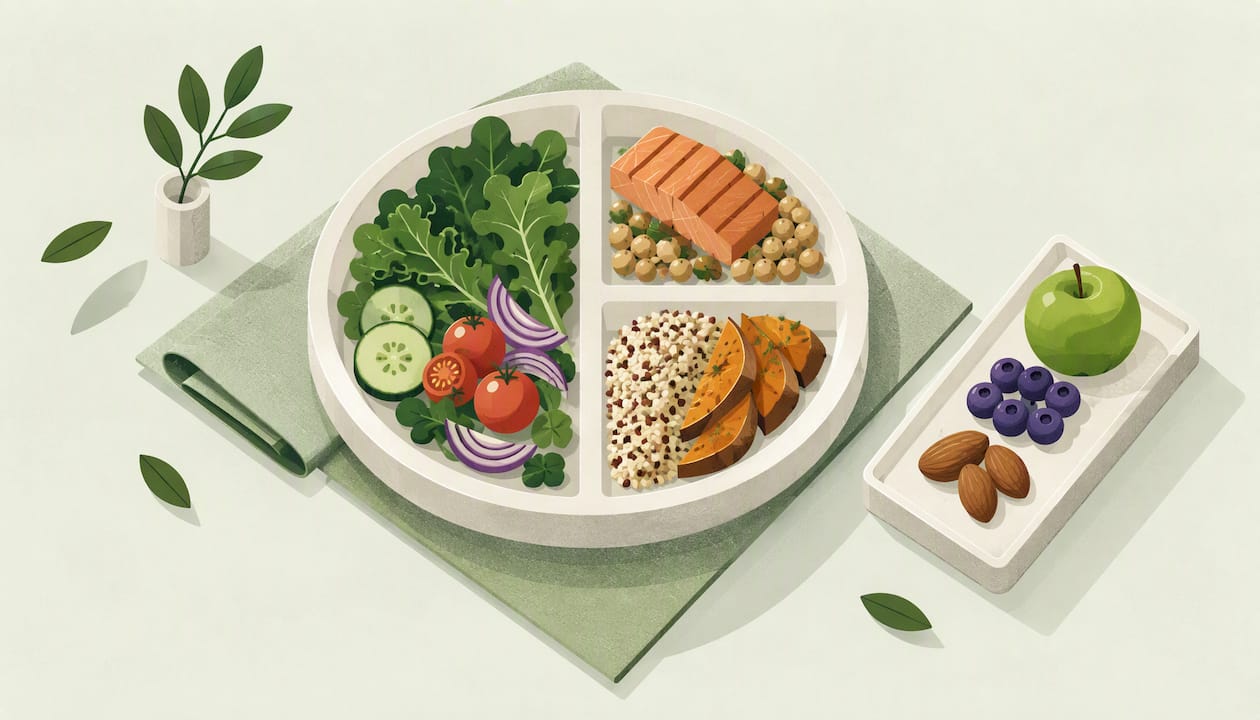
The plate method gives you a rough macro split without any counting. Fill half a 9-inch plate with non-starchy vegetables, one quarter with lean protein and one quarter with carbohydrate-rich foods, and you get a balanced meal. You also get a sensible amount of protein, fiber and energy. It is not a precise macro system, but it is a very good starting point. With a few tweaks it works for fat loss, for muscle gain and for couples who eat the same dinner.
Below you will see what the plate gives you in macro terms, how to adjust it for your goal, and when it makes sense to add real numbers on top.
Log meals by photo, voice, text, barcode or manual entry, then compare calories and macros with your personal daily goal.
Get the AppTL;DR
- Half non-starchy vegetables, one quarter lean protein, one quarter carbs (grains or starchy vegetables), plus a thumb of added fat. That is the whole method.
- The plate controls volume and food quality, not grams. It does not land on a fixed ratio like 40/40/20.
- For muscle, keep the protein quarter at roughly 20 to 30 g per meal and add carbs on heavy training days.
- For fat loss, the plate is a strong first step, but sustained results depend on sticking with it, so a light tracking habit helps.
- Check your plate against real numbers for a week or two. After that, your eye gets much better.
What the plate method actually is
The plate method is a visual portion guide. Instead of weighing food, you divide your plate into sections and fill each with a food group. Several versions exist, and they agree on the basics.
The version used in diabetes education starts with a plate about 9 inches across. Non-starchy vegetables take half, protein foods take a quarter, and the last quarter holds carbohydrate foods. Harvard’s Healthy Eating Plate uses a similar layout, with vegetables and fruits filling half the plate, whole grains a quarter and healthy protein a quarter.
Two details matter more than people expect:
- The plate size. A 9-inch plate holds noticeably less than the 11 or 12-inch dinner plates many American kitchens use. If your plate is bigger, the quarters get bigger too, and so does the meal.
- What counts as a vegetable. Broccoli, peppers, salad greens, green beans and zucchini fill the half. Corn, peas and potatoes belong in the carb quarter.
Translating the plate into macros
Macros are the three nutrients that supply most of your calories: protein, carbohydrates and fat. The plate method never names them, but it shapes all three.
| Plate section | What goes there | Main macro | Why it matters |
|---|---|---|---|
| Half | Non-starchy vegetables | Small amounts of carbs, plenty of fiber | Volume and fullness for few calories |
| Quarter | Lean protein (chicken, fish, eggs, tofu, beans, Greek yogurt) | Protein | Muscle repair and satiety |
| Quarter | Rice, pasta, oats, potatoes, whole-grain bread, fruit | Carbohydrate | Energy for work and training |
| Extras | Olive oil, nuts, cheese, dressing | Fat | Flavor, absorption of fat-soluble vitamins |
The fat is the part that hides. Cooking oil, dressing, cheese and nuts do not take up a quarter of the plate, but they pack a lot of energy into a small spoonful. That is where most plates drift away from the plan.
Does it match a target like 40/40/20?
Not exactly, and it is not trying to. The plate method focuses on food quality and portion volume rather than a percentage split. For context, the Dietary Guidelines range, as summarized in a randomized trial on portion-controlled meals, is 45 to 65% of energy from carbohydrate, 20 to 35% from fat and 10 to 35% from protein. A typical plate built the standard way lands inside those ranges for most people.
If you are chasing a particular ratio, such as a higher-protein split for lifting, the plate will get you in the neighborhood and the numbers will do the rest. You can learn how to set those targets in our five-step guide to calculating macros.
Does the plate method work for weight loss?
It can help, with caveats. The reason is simple: portion size drives how much we eat. A review of portion control in weight management notes that serving people larger portions leads to substantial increases in energy intake, and that the effect holds up over weeks. The same review reports that portion-control tools used for around six months produced greater weight loss than usual care, in the range of 1.8% to 2.4% in the tool groups versus 0.1% to 0.5% in the comparison groups. Those are modest, average figures from trials, not a promise for any one person.
The plate works for three practical reasons:
- It lowers energy density. Filling half the plate with vegetables adds volume and fiber with relatively few calories.
- It protects protein. A dedicated protein quarter makes it hard to skip.
- It needs no equipment. You can use it at a restaurant, at a friend’s table or at your desk.
The weak point is adherence. Dietary management research on obesity points out that structure helps early on, but long-term results depend on building a reliable sense of portions. In other words, the plate is a good scaffold, and you still need a way to learn whether your eyeball estimates are accurate.
If you have diabetes, prediabetes or another medical condition, ask your doctor or a registered dietitian how to adapt the plate. The CDC’s diabetes meal planning page lists the plate method alongside carb counting as a way to plan meals, but the right portions for you depend on your medication and your numbers.
How to build the plate, step by step
- Pick a 9-inch plate. If you only have larger ones, mentally draw the same circle inside the rim, or use a salad plate.
- Fill half with vegetables. Aim for two colors. Roast them, steam them or eat them raw. Go easy on butter and heavy dressings.
- Add your protein to one quarter. A palm-sized portion, about the size of a deck of cards, is roughly 3 oz of cooked meat or fish. Eggs, tofu, lentils and Greek yogurt work too.
- Fill the last quarter with carbs. Brown rice, quinoa, whole-wheat pasta, sweet potato, beans or a piece of fruit.
- Add fat on purpose. About a thumb of olive oil, cheese or nuts. Measure it the first few times so you know what a thumb really is.
- Drink water first. A glass before you sit down helps you judge fullness more clearly.
Visual anchors that save time
- Palm: one protein serving
- Fist: one serving of rice, pasta or fruit
- Cupped hand: a serving of nuts or granola
- Thumb: one serving of oil, nut butter or cheese
Hands are not lab instruments, but they travel with you, and that is the point.
Adapting the plate to your goal
The plate is a baseline. The CDC’s meal planning guidance and sports nutrition experts both treat it as something you adjust, not a rule you obey.
If you want to lose around 10 kg
Keep the standard plate and focus on the leaks: oils, sauces, drinks, snacks. Make the vegetable half genuinely half, not a garnish. Keep the carb quarter to a true quarter, and measure the fat for a couple of weeks. If you are not sure how much to eat in total, a calculator workflow for fat-loss macros shows how to set a daily calorie and macro target from your own numbers.
A gradual, steady approach is easier to keep than a drastic one. If you have a lot to lose, or any health condition, plan the pace with your doctor or a registered dietitian.
If you want to build muscle
The plate can serve as a floor for protein, as long as the protein quarter stays consistent. Sports nutrition guidance suggests 20 to 30 g of protein per meal to stimulate muscle protein synthesis, and 1.2 to 2.0 g per kg of body weight per day for athletes and routinely active adults, depending on training load.
A quick worked example. Say you weigh 80 kg and aim for 1.6 g/kg. That is 128 g of protein a day. Over four meals, that is 32 g each, which is about a palm and a half of chicken or fish per sitting, or a palm of meat plus a cup of Greek yogurt. If three palm-sized portions leave you short, add a protein snack rather than shrinking the carbs.
On heavy training days, make the carb quarter slightly bigger or add a piece of fruit. On rest days, bring it back to a quarter. You can find more on setting those targets with our macro calculator. For a deeper look at how athletes scale their intake to body weight, see these weight-adjusted macros for athletes.
If you are recovering from an injury
When training drops, your plate can shift: keep protein steady, keep vegetables generous and trim the starchy carbs to match the lower activity. Do not cut energy sharply while you heal. A sports dietitian or your doctor can tell you what is right for your injury.
Where the plate method falls short
Being honest about the limits makes the method more useful.
- Mixed dishes. Curries, burritos, casseroles and stir-fries do not sort neatly into quarters. You estimate, and estimates drift.
- Hidden fat. A restaurant plate can carry far more oil and butter than a home plate looks like it does.
- Calorie-dense foods in the “right” section. Granola, dried fruit and fatty cuts of meat all fit a quarter but weigh in heavy.
- No personal target. The plate does not know if you need 1,800 calories or 2,800.
These gaps are the reason many people eventually pair the plate with some tracking. Our guide to counting calories without weighing food covers lighter-touch ways to do that, and the post on macro-friendly restaurant orders shows how to apply the plate when someone else is cooking.
Our take: use the plate to learn, then verify
At Cibo, we see the plate method as the best first habit in nutrition. It is easy to remember, it works anywhere and it moves your meals toward more vegetables and enough protein. We also see where people get stuck: they cannot tell whether their “quarter” of rice is 150 or 400 calories, or whether their dinner really delivered 30 g of protein.
Our advice is to use the plate for decisions and numbers for feedback. Log your plates for two weeks. Compare what you thought you ate with what the data says. Most people find one or two consistent gaps, such as oil or portion size of the carb quarter, and fix them. After that, you can go back to eyeballing with a much more accurate eye. That matches the research on portion control: structure helps, but building your own sense of portions is what lasts.
We also think food should not be a solo project. When a couple or a group of friends share the same plate structure, dinner gets simpler, and you can see each other’s progress and cheer each other on.
Plate method for couples and busy weeks
The plate is easy to share. One person’s plate can have a bigger carb quarter for training, the other a bigger vegetable half, and both come from the same pots. Cook one protein, one vegetable and one starch, and let each person plate their own proportions.
For planning, a simple routine helps:
- Pick two proteins, two vegetables and two starches for the week.
- Batch-cook them on Sunday.
- Mix and match into plates through the week.
If you are new to cooking, a beginner cooking planner can help you set up a grocery list and a kitchen that makes this routine easy.
Add numbers to your plate with Cibo
If you want the plate plus real feedback, Cibo is an AI calorie and macro tracker for iOS and Android. Snap a photo of your plate, or log by voice, text, barcode or manual entry, and you get calories, protein, carbs and fat based on USDA FoodData Central, plus your daily balance against a personal goal. Together mode lets a partner or friend follow along side by side.
It is a 7-day trial, then subscription: Cibo Pro is $39.99 per year on iOS and Android, or $6.99 per month on iOS and $4.99 per month on Android. See the pricing details or learn how to find food calories fast using USDA data.
FAQ
What does the 40/40/20 macro rule mean?
It is a split of 40% of calories from carbohydrate, 40% from protein and 20% from fat. The plate method does not target it. The plate focuses on portion volume and food quality, and a typical plate lands within the broader ranges of 45 to 65% carbs, 20 to 35% fat and 10 to 35% protein.
What is the 9-inch plate method?
It is the version used in diabetes education. You use a 9-inch plate, fill half with non-starchy vegetables, a quarter with protein and a quarter with carbohydrate foods. The smaller plate keeps total portions in check.
Can I build muscle with the plate method?
Yes, if you keep the protein quarter consistent at about 20 to 30 g per meal and add carbs on training days. Check your daily total against a target between 1.2 and 2.0 g per kg of body weight, and track for a while to confirm you are hitting it.
How long should I track if I use the plate method?
Two to four weeks is enough for most people to calibrate their eye. Log your usual meals, spot the gaps, and then track only occasionally to check in. If you have a medical condition, ask your doctor or dietitian what is right for you.
Sources
- Healthy Eating Plate, The Nutrition Source (Harvard)
- The Plate Method, UGA Extension
- Randomized Clinical Trial of Portion-Controlled Prepackaged Foods to Promote Weight Loss, PMC
- What is the role of portion control in weight management? PMC
- Dietary Management of Obesity: Cornerstones of Healthy Eating Patterns, PMC
- Diabetes Meal Planning, CDC
- The Emerging Science of Rehabilitative Nutrition, ACSM Southeast
Recommended
Not medical advice. Cibo is a nutrition-awareness tool, not a medical device. Read the full disclaimer.
Build healthier habits with Cibo
Nutrition made simpler for everyday life.


