
Real-Time Nutrition Insights: How to Use Them Well
Real-time nutrition insights show what a meal does to your day while you can still act. Learn what to log, how to read the numbers and how to stay consistent.
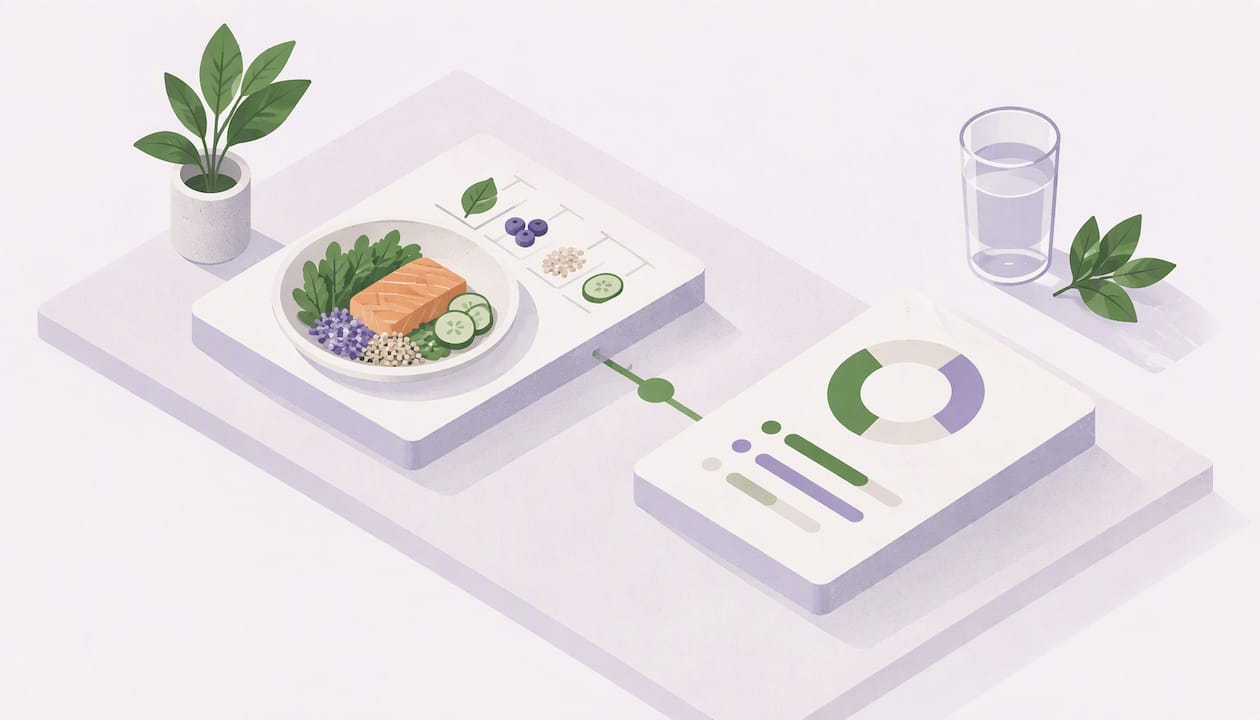
Real-time nutrition insights are simply your calories, protein, carbs and fat shown to you at the moment you eat, set against a daily goal, so you can adjust the next meal instead of regretting the last one. The tools are easy to find. The hard part is knowing which numbers to trust, which ones to act on and how to keep going after the first few weeks. This guide covers all three.
Log meals by photo, voice, text, barcode or manual entry, then see calories and macros against your daily goal.
Get the AppTL;DR
- Real-time insight means logging in seconds (photo, voice, text, barcode) and seeing your balance against a goal right away, not reviewing a food diary at the end of the week.
- Research links real-time digital tracking to more consistent self-monitoring, but an app alone does not change behavior. Your habits do.
- You do not need perfect logs. Logging at least two eating occasions a day was the best marker of adherence in two weight loss trials.
- Treat photo estimates as a starting point and check anything that looks odd against a standard portion.
- Use reference targets (FDA, WHO, NIH) as guardrails, and see a doctor or registered dietitian if you have a medical condition.
What “real-time” actually changes
A paper food diary tells you what happened. A real-time insight tells you what is happening. If it is 1 p.m. and you can see that you are well short on protein and already near your carb target, lunch and dinner become choices instead of guesses.
This timing matters for a practical reason: memory is a poor logger. Most of us forget the handful of nuts, the second coffee with milk, the oil in the pan. When logging takes a few seconds and happens as you eat, those small items make it into the record.
One caution from the research: simply moving from paper to an app does not automatically produce more weight loss. The benefit comes from making consistent self-monitoring feasible. The insight only helps if you do something with it.
The four insights worth checking every day
A dashboard can show dozens of metrics. For most adults 25 to 45 who want to lose some weight or build muscle, four are enough.
1. Calories against your goal
Your daily calorie target depends on your size, activity and goal. If you do not have one yet, the calorie, macro and TDEE calculators give you a reasonable starting estimate. Treat it as a starting point, then adjust based on how your body and your trend respond over a few weeks.
2. Protein
Protein is the macro most people under-count. For athletes, the NIH Office of Dietary Supplements notes that protein needs are typically 1.2 to 2.0 grams per kilogram of body weight, which is roughly 0.5 to 0.9 grams per pound. The same source describes spreading intake through the day, about 0.14 grams per pound of body weight (around 20 grams for a 150 lb person) every 3 to 5 hours.
A real-time view helps here because you can see at 3 p.m. that you have had 25 grams so far, and plan a protein-forward snack rather than cramming it in at night.
3. Carbs and fat balance
The WHO’s 2023 guidance suggests limiting total fat to under 30% of daily energy intake and saturated fat to under 10%. You do not need to hit these to the decimal. Use them as guardrails when your fat or saturated fat looks consistently high.
4. Fiber and sodium (the label check)
Packaged food gives you a free reality check in the Nutrition Facts panel. The FDA explains that 5% Daily Value or less per serving is low and 20% or more is high. Its reference values, based on a 2,000-calorie diet, include 50 g protein, 275 g total carbohydrates, 28 g fiber and less than 2,300 mg sodium. They are population-level references, not your personal prescription.
How to log so the insights are worth trusting
The quality of an insight is capped by the quality of the entry behind it. Here is a simple routine that keeps things fast without sacrificing accuracy.
- Log before or as you eat. A photo or a short voice note takes seconds. Doing it later is where the forgotten snacks come from.
- Use a barcode for packaged food. The label is already printed on the product, so scanning removes most of the guesswork.
- Use photo or voice for home cooking and restaurant meals. These are the entries where convenience matters most.
- Check the portion, not just the food. Most errors come from portion size. Visual anchors help: a palm is roughly one protein serving, and a deck of cards is about 3 oz of cooked meat.
- Review the day once. Glance at your balance in the evening. Do not agonize over it.
Be honest about photo estimates
Photo logging is a real convenience, but it is still maturing. A research overview notes that most apps still rely heavily on text-based databases for accuracy and that you should double-check the estimate against standard portions when a result looks unusual. Mixed dishes, sauces and layered foods are the hardest for any camera.
A good habit: if a photo result surprises you, edit the portion or switch to text or manual entry. For a home recipe, our guide to estimating recipe calories from USDA data shows the method step by step.
Where the numbers come from
Not all nutrition data is equal. Entries submitted by users can vary widely for the same food. Data built on USDA FoodData Central, the U.S. government’s food composition database, gives you a consistent reference. If you want to look up a single food quickly, see our walkthrough on finding calories in food with USDA data. To see how this looks for a specific food, the page for cod calories and macros lists values per fillet.
Why your results may differ from a friend’s
Two people can eat the same meal and respond differently. Dr. Sarah Berry, Professor of Nutritional Sciences at King’s College London and Chief Scientist at ZOE, describes nutrition as deeply personal, with metabolism and the gut microbiome shaping how each person processes food.
What this means for you in practice:
- Calorie and macro counts tell you what is in the food. They do not predict how hungry, energized or satisfied you will feel afterward.
- Notice patterns in your own days. If a certain breakfast keeps you full until lunch and another does not, that is useful information.
- If you want individualized guidance, especially with a health condition, talk with a doctor or registered dietitian. Some clinics also offer in-person nutritional counseling as part of a broader care plan.
Tracking gives you the raw data. A professional can help you interpret it in light of your health history.
Staying consistent after week ten
Tracking adherence often falls after the first 10 weeks of a program. That is normal, not a character flaw, and you can plan for it.
The research gives a gentler standard than “log everything”. In two six-month randomized weight loss trials, tracking at least two eating occasions per day was the best marker of adherence. Here is how to use that.
- Set a floor, not a ceiling. Two logged meals or snacks on a busy day counts as a good day.
- Log the meals that matter most. If protein is your focus, log the protein-heavy ones. If calories are, log the unpredictable ones, like restaurant meals.
- Do not restart from zero after a missed day. Log the next meal and move on.
- Pick your cue. Phone out at the table is a cue. So is logging with your first coffee.
- Bring a partner. Accountability is easier when someone is in it with you. Together mode lets partners and friends follow each other’s progress and cheer each other on.
Privacy: know what you share
Tracking apps hold sensitive information about your habits. Researchers reviewing nutrition apps note that privacy remains a top concern for users, and that data security is worth considering when you choose a tracking method. Before you commit, check what an app collects and who it shares it with. Our practical guide to health app privacy walks through what to look for.
Our perspective
We build a nutrition tracker, so we have a bias, and we will name it: we think precision matters, but only up to the point where it stops being sustainable.
The frustration we hear most is not “I do not know what to eat”. It is “logging takes too long, so I quit”. Spreadsheet-style macro trackers can be thorough, but they ask a lot of you at every meal. Photo-only apps are fast, but they can leave you guessing about what the number is based on.
Our view is that the best setup is the one that sits in the middle. Log in whichever way is quickest at that moment: photo, voice, text, barcode or manual entry. Anchor the numbers to USDA data. Look at one clear daily balance against a personal goal. Then correct the entries that look off rather than trusting or ignoring everything.
We also think accountability is underrated. Eating habits live in households and friendships, so tracking is easier when the people around you can see the same picture and nudge you in the right direction.
A simple daily workflow
Here is what a realistic day can look like for a busy professional aiming to lose around 10 kg over time or to build muscle, with the pace set by you and your doctor or dietitian rather than by any app.
| Time | What you do | Insight to check |
|---|---|---|
| Morning | Log breakfast by photo or barcode | Protein so far, calories left |
| Midday | Voice-log lunch, check the portion | Is protein on pace? |
| Afternoon | Log a snack if you have one | Carbs and fat balance |
| Evening | Log dinner, then glance at the whole day | Daily balance against your goal |
If you miss a slot, remember the two-meal floor from above and carry on.
Try it with Cibo
If you want this workflow in one place, Cibo is an AI calorie and macro tracker for iOS and Android. You log a meal by photo, voice, text, barcode or manual entry, and get calories, protein, carbs and fat based on USDA FoodData Central, then see your daily balance against your own goal. Pro is a 7-day trial, then subscription: $39.99 per year on iOS and Android, or monthly at $6.99 on iOS and $4.99 on Android. You can see the details on the pricing section.
Common mistakes to avoid
- Trusting every estimate equally. Check portions on mixed dishes.
- Chasing perfection. A mostly complete log beats an abandoned one.
- Ignoring trends. One high day means little. Look at the week.
- Using the numbers as a verdict. They are information, not a grade on you as a person.
- Skipping professional input. If you have diabetes, a history of disordered eating, are pregnant or take medication that interacts with diet, ask your doctor or a registered dietitian before changing how you eat.
FAQ
What are real-time nutrition insights?
They are calorie, macro and nutrient numbers shown right after you log a meal, compared against a daily goal. The point is to adjust the rest of your day while it is still happening. They work best when your logging is quick enough to do at every meal.
How do I track my nutrition intake without it taking over my day?
Start with the quickest input for each situation: barcode for packaged food, photo or voice for everything else. Aim for at least two logged eating occasions a day, which research on mobile tracking found to be the best marker of adherence. Then review your balance once in the evening.
How accurate is AI photo logging?
It is useful but not perfect. A review of dietary record apps notes that the technology is still advancing at recognizing complex foods, so check unusual results against standard portions. For mixed dishes, adjust the portion or add details by text.
How do I read the daily value on a nutrition label?
Look at the % Daily Value column. The FDA says 5% or less is low and 20% or more is high per serving. Those values assume a 2,000-calorie diet, so your own needs may differ.
Sources
- FDA: How to Understand and Use the Nutrition Facts Label
- WHO: updated guidelines on fats and carbohydrates (2023)
- NIH Office of Dietary Supplements: Exercise and Athletic Performance
- Fueled by Science: Dr. Sarah Berry interview
- PMC: moving from paper to app and real-time self-monitoring
- PMC: tracking at least two eating occasions per day
- PMC: validation studies of dietary record apps
- PMC: mobile apps for dietary assessment in clinical research
Recommended
Not medical advice. Cibo is a nutrition-awareness tool, not a medical device. Read the full disclaimer.
Build healthier habits with Cibo
Nutrition made simpler for everyday life.


