
How to Track Macros Without Weighing Your Food
You can track macros without a food scale. Learn hand portions, label shortcuts, photo logging and a simple routine that keeps your estimates honest.
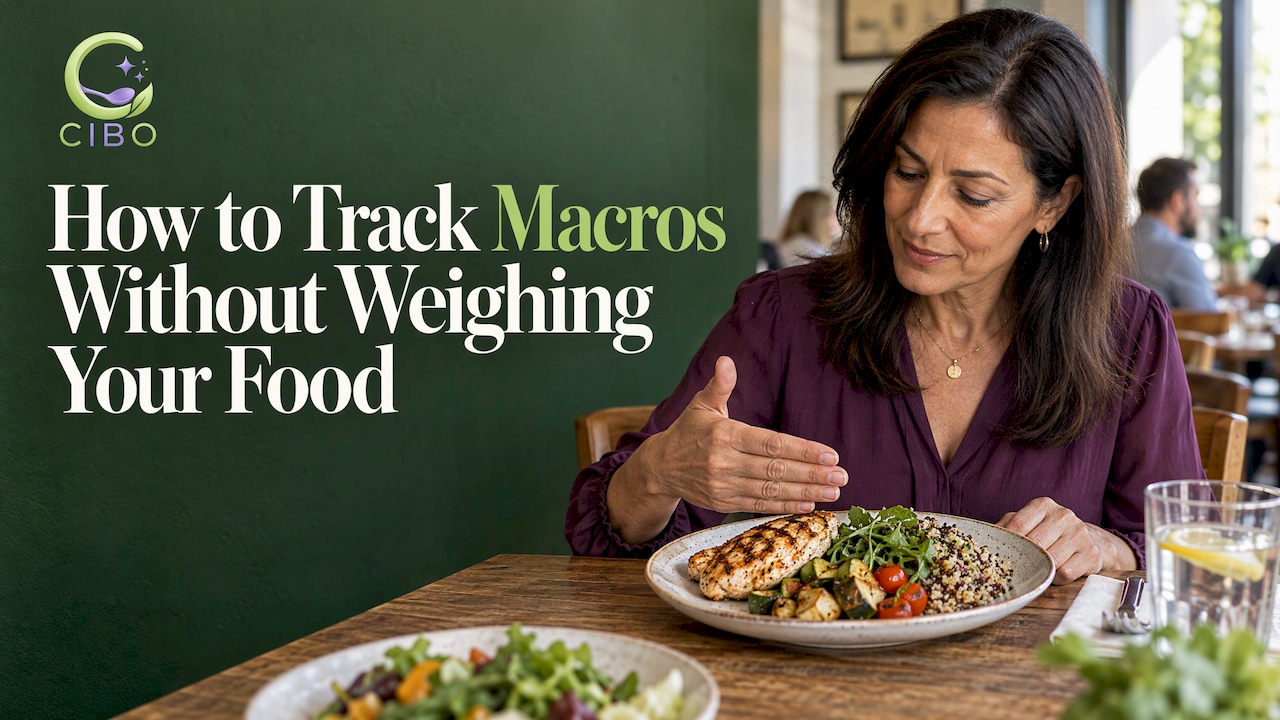
You can track macros without a food scale. Estimate portions with your hand, read the serving size on the label, log from a photo or a quick voice note, and judge your numbers by the weekly pattern rather than by any single meal. A scale is the most exact tool, but it is not the only way to get a useful picture of your protein, carbs and fat.
This guide shows you how, step by step, with the methods that hold up best and the places where estimates tend to slip. You will also get a simple routine you can keep up when life gets busy.
Log meals by photo, voice, text, barcode or manual entry, then see your calories and macros against a personal goal.
Get the AppTL;DR
- Use your hand as a built-in measuring tool: palm for protein, fist for vegetables, cupped hand for carbs, thumb for fat.
- Start with the serving size on the label, then compare it with what you actually ate.
- Begin by tracking protein only for a week or two, then add carbs and fat.
- Aim for a good estimate most days. Consistency over weeks matters more than perfect numbers at one meal.
- Photo, voice, text and barcode logging in an app can take the arithmetic off your plate.
Why you do not need a scale to get useful macro numbers
Weighing every ingredient sounds precise, but it is also the reason many people quit. It takes time, it is awkward at restaurants, and it makes a normal dinner feel like a lab test.
The goal of macro tracking is a pattern you can act on. Ari Howard, a licensed mental health counselor, makes the point in Healthline’s guide to tracking macros without letting it take over your life: consistency over time matters more than daily perfection, and when you eat out, a best estimate is enough before you move on.
That shifts the question. Instead of asking, “Is this exactly 31 grams of protein?” you ask, “Is this roughly a normal serving, and is it moving me toward my daily goal?” The methods below answer that second question quickly.
Method 1: Use your hand as a measuring tool
Your hands travel with you, they are always available, and they are generally proportional to your body size. That is why Precision Nutrition recommends them as a practical reference when cups and scales are not around.
The basic system, described in Precision Nutrition’s hand portion guide, works like this:
| Food group | Hand measure | Rough size |
|---|---|---|
| Protein (meat, fish, eggs, tofu) | One palm | About 3 oz |
| Vegetables | One fist | About 1 cup |
| Carbohydrates (rice, pasta, potatoes) | One cupped hand | About 1/4 cup per Clemson, see below |
| Fats (oils, nut butter, butter) | One thumb | About 1 tablespoon |
The sizes in the right column come from Clemson Extension’s portion guide, which lists a palm as about 3 ounces, a fist as about 1 cup, a cupped hand as about 1/4 cup and a thumb as about 1 tablespoon. Cupped-hand sizes vary from person to person, so treat that figure as a starting point, not a rule.
How to log a meal with hand portions
- Look at your plate and count the portions: one palm of chicken, two fists of vegetables, one cupped hand of rice, one thumb of olive oil.
- Enter those as standard servings in your tracker, for example 3 oz of chicken breast, 2 cups of vegetables.
- Let the app’s database turn those amounts into calories and macros.
Two small rules keep this accurate. First, judge cooked food as cooked and raw food as raw. Precision Nutrition advises sizing foods eaten cooked after cooking and foods eaten raw before eating. Second, size the portion by thickness and width of the palm, not by fingers.
If you want a deeper walk-through, our guide to the hand portion method covers it in more detail.
How accurate is hand estimating?
Better than you might expect, with some limits. A 2016 peer-reviewed study in the Journal of Nutritional Science found that 80 percent of geometrically shaped foods and liquids estimated with the finger-width method landed within 25 percent of true weight, compared with 29 percent when household measures were used.
The same study concluded that finger-width estimation works best as a complement to other methods, because it does not suit every food shape. Neat shapes such as a chicken breast, a slice of bread or a block of tofu are easy to judge. A pile of mixed stir-fry or a casserole is harder.
Method 2: Compare food with everyday objects
Some people find objects easier than hands. The U.S. National Library of Medicine’s MedlinePlus portion size guide recommends using your hand and common objects to estimate portions, and it offers these comparisons:
- A deck of cards or your palm: one serving of meat or poultry.
- A checkbook: about 3 ounces of fish.
- A tennis ball: 1/2 cup of ice cream.
- A rounded handful or a tennis ball: 1/2 cup of cooked rice, pasta or snacks.
- A ping-pong ball: 2 tablespoons of peanut butter.
The Veterans Health Library offers similar anchors: 2 to 3 ounces of meat, poultry or fish looks like a deck of cards or a palm, 1 tablespoon is about the first two joints of your thumb, and 1/2 cup is about a tennis ball.
One useful distinction from MedlinePlus: a portion is what you actually eat, while a recommended serving is the amount intended for a meal or snack. Your portion may be larger or smaller than the serving. When you log, record what you ate, not what the package suggests.
Method 3: Let the label do the measuring
Packaged foods are the easiest to log without a scale, because the work is already done. Start with the serving size and the household or metric amount at the top of the Nutrition Facts panel, then compare it with what you ate.
Health Canada explains that the nutrition information is based on the stated serving size, and that a serving size is a reference amount, not a recommendation. The same idea applies to US labels.
A quick routine:
- Find the serving size and servings per container.
- Decide how many servings you ate: half, one, one and a half, two.
- Multiply the protein, carbs and fat by that number, or scan the barcode and set the serving count in your app.
Clemson Extension recommends checking Nutrition Facts serving sizes even when you use hands or objects, because each food defines a serving differently. A serving of cereal and a serving of cheese do not look alike.
Method 4: Log by photo, voice, text or barcode
The most common reason people drop macro tracking is friction. If logging takes five minutes per meal, it will not last. Photo and voice logging shrink that to seconds, because the app identifies the food, estimates the portion and does the macro math.
Research on photo-based estimation is encouraging with a few lessons built in:
- A study of 100 food samples found that computer-derived volume estimates had a mean relative error of −2.8 percent, with 85 samples within 30 percent of physical measurements.
- Older work on photographs found that estimated meal nutrients were generally within 7 percent of actual values when butter and margarine were excluded. Small portions tended to be overestimated and large ones underestimated, and added fats such as butter were substantially overestimated.
- A 2018 study of visual aids found accuracy improved with 45-degree images compared with 90-degree images, 35 percent versus 25 percent within 20 percent of actual weight.
Translation for your kitchen: shoot your plate at an angle rather than straight down, keep the food visible and not buried under sauce, and add a quick note for hidden fats like oil or butter. Our food photo tips for tracking go through exactly how to do that.
Where Cibo fits
If you want one tool for all of this, Cibo lets you log a meal by photo, voice, text, barcode or manual entry. It returns calories, protein, carbs and fat based on USDA FoodData Central, and shows your daily balance against a personal goal. So you can eyeball a portion, snap it, and move on without a scale.
Cibo Premium is available for iOS and Android with a 7-day trial, then subscription: $39.99 per year on both platforms, or $6.99 per month on iOS and $4.99 per month on Android. You can see the current options on the Cibo pricing page.
Estimating homemade, restaurant and unlabeled food
This is where most “no scale” attempts get shaky, so it helps to have a plan.
Homemade meals
For recipes, the trick is to do the math once and reuse it. Add up the main ingredients in the pot, divide by the number of servings you get, and save the result as a recipe. After that, logging dinner is one tap. Because you cook the dish yourself, you can use measuring cups and spoons, or count the packaged amounts you used (one can of beans, two chicken breasts), without any scale.
If the finished dish is even, such as a lasagna or a sheet-pan bake, cutting it into equal pieces by eye works well. If it is uneven, such as a stew, use a ladle or a measuring cup to portion it once, then repeat that same scoop every time.
Restaurants and hot bars
When there is no label, break the plate into its parts: a palm of protein, a fist of vegetables, a cupped hand of starch, a thumb or two of fat. Then add a little extra for cooking oil and sauces, because those are the items estimates miss most often. Our restaurant calorie estimation guide gives a more detailed routine for eating out.
If you cannot tell what is in a dish, choose the closest match in your tracker, log your best estimate and keep going. Howard’s advice in the Healthline piece applies here: do your best and move on, because progress is built on patterns.
Foods that are hard to judge
The 2016 hand-measure study suggests geometric foods are easier to estimate than amorphous ones. So for mixed dishes, lean on a different tool: a measuring cup, a standard bowl you always use, or a bowl size you have checked once. If you use the same bowl every day, “one bowl” becomes a consistent unit.
Build a simple routine that lasts
Getting the method right matters less than being able to keep doing it. These steps come from the approach Healthline lays out and from the evidence above.
- Start with protein only. Healthline suggests tracking just one macro, typically protein, for a week or two. When that feels easy, add carbs, then fat.
- Save your regular meals. Most of us eat the same dozen breakfasts and lunches. Save them so you can repeat them in a tap.
- Allow a range. Healthline recommends staying within 5 to 10 grams of each macro target on most days instead of chasing exact precision.
- Consider days off. Some people track five days and rest two, using those days to practice noticing hunger and fullness.
- Check in weekly. Look at your averages. If your estimates are steady and your goals are on track, you are doing it right.
If you are deciding what to track first, our explainer on calories versus macros shows why many people start with calories and add protein next.
A short calibration week
Here is a trick that helps your eyes learn. Pick the five or six meals you eat most often. For one week, weigh or measure them once, note how they look on your plate and in your hand, and save them. After that you will have a mental picture of your own usual portions, and you can eyeball with more confidence. A trainer-written guide, Visiting Trainer, suggests a similar focused period of measuring your most common meals.
This is a one-time investment, not a lifelong habit. After a couple of weeks you can put the scale in the cupboard.
Common mistakes and how to avoid them
- Forgetting cooking fats. A splash of oil in the pan is easy to skip, yet it is one of the most commonly missed items. Log one thumb or one tablespoon whenever you cook with oil or butter.
- Mixing cooked and raw. Pick one state and stick with it. Rice weighed cooked and rice entered as dry will give very different numbers.
- Ignoring the serving size on the label. A small bag may contain two servings. Check before you log.
- Chasing perfection. If you miss a meal, estimate it or skip it, then continue tomorrow. One imperfect day does not undo a good week.
- Changing methods every week. Choose one approach and keep it consistent. Small errors tend to cancel out over a day when you estimate the same way each time.
Tracking with a partner or friend
Accountability helps many people keep going. In Cibo’s Together mode, partners and friends can follow each other’s progress and encourage each other, so logging feels less like a chore you do alone. It is a gentle nudge on the days when you would rather skip.
Frequently asked questions
Is it okay to track macros without weighing food?
Yes. Estimates from hands, objects, labels and photos give you a workable picture, especially when you apply them the same way every day. Studies on hand-based estimating show it can be reasonably close for many foods, though it works best alongside other methods. If you have a medical condition that needs precise numbers, ask your doctor or a registered dietitian how to track.
What is the easiest macro to start with?
Protein. Healthline suggests tracking just protein for a week or two before adding carbs and fat. A palm of meat, fish, tofu or eggs at each meal is a simple anchor to begin with.
How do I track macros at a restaurant?
Break the plate into palm, fist, cupped hand and thumb portions, add a little for oil and sauces, and log your best estimate. You can also photograph the plate at a slight angle so your app can read it. Do not worry about exact numbers, since a consistent estimate serves you better than skipping the meal.
How do I log packaged food quickly?
Scan the barcode or read the serving size on the Nutrition Facts panel, then multiply by the number of servings you ate. Remember that the serving size is a reference amount, so your own portion may be bigger or smaller.
Will I ever need a scale again?
Not necessarily. A short calibration period with your most common meals can train your eye. You can always bring the scale back for a week if your estimates start to feel off.
Sources
- Healthline: How to Track Your Macros Without It Taking Over Your Life
- Precision Nutrition: Hand Portion FAQ
- Precision Nutrition: How to Do Hand Portion Math to Track Your Macros
- Clemson Extension: Measuring Portions
- Journal of Nutritional Science: Accuracy of hands v. household measures
- MedlinePlus: Portion size
- Veterans Health Library: How to Judge Serving Sizes
- Health Canada: Nutrition Facts table
- Accuracy of food portion size estimation from digital images
- British Journal of Nutrition: Food photography II
- Nutritional Epidemiology study on visual aids
- Visiting Trainer: How to Track Macros Without Weighing Every Meal
Recommended
Not medical advice. Cibo is a nutrition-awareness tool, not a medical device. Read the full disclaimer.
Build healthier habits with Cibo
Nutrition made simpler for everyday life.


