
Restaurant Calorie Estimation: A Practical Guide for Eating Out
Learn how to estimate calories and macros in restaurant meals: where to find real numbers, how to size portions, and how to log a range when you can't be sure.
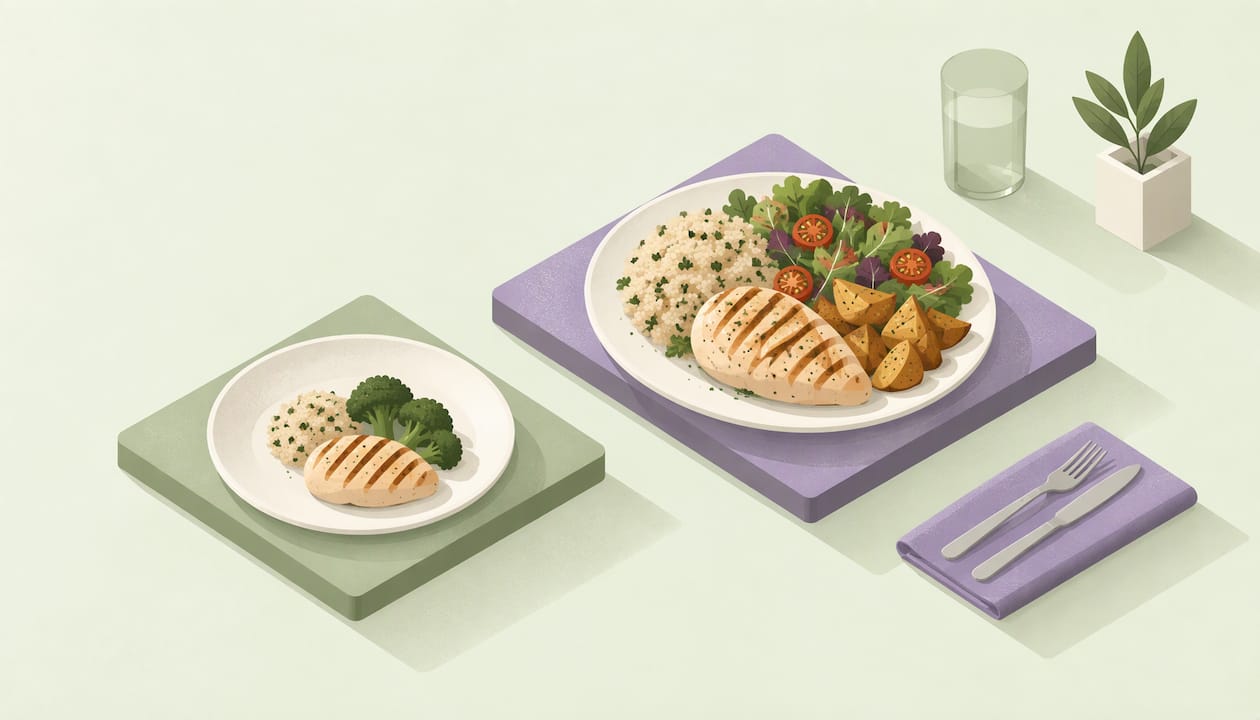
The most reliable way to estimate restaurant calories is to use the chain’s published numbers when they exist. When they don’t, break the plate into parts, size each part with your hand, add the oil, butter and sauce you can’t see, and log a range instead of one exact figure. You won’t get a perfect number. You can get one that is close enough to keep your week on track, and this guide shows you how.
Cibo lets you log meals by photo, voice, text, barcode or manual entry, then track calories and macros against your daily goal.
Get the AppTL;DR
- Check the menu, the restaurant’s website or app first. Large U.S. chains are required to list calories, and you can ask for more detail.
- No numbers? Split the meal into protein, starch, vegetables, fats and sauces. Size each one with your hand.
- Restaurant portions often run bigger than you expect, and hidden fats add up quickly. Build a cushion into your estimate.
- Even published figures are averages. Log a sensible range and move on rather than chasing a perfect number.
- Record what you actually ate, not what you meant to order.
Start with the numbers the restaurant already has
Before you estimate anything, see whether someone has done it for you. In the United States, the FDA explains that covered chain restaurants and similar retail food establishments with 20 or more locations must list calories on menus and menu boards. They must also provide written nutrition information, such as saturated fat, sodium and fiber, if you ask for it.
In practice that gives you three places to look:
- The menu or menu board. Calories appear next to each item.
- The restaurant’s website or app. Many chains publish a full nutrition sheet or an interactive builder. Look for protein, carbohydrate and fat columns if you track macros.
- The counter. Ask for the written nutrition information. Staff at covered chains are expected to hand it over.
One detail trips people up: check the serving definition. A sheet may list a side, a half portion or a component, not the whole plate you were served. If you ate the full bowl, multiply accordingly.
Independent restaurants, local diners and food trucks usually aren’t covered. That’s where estimation starts.
Why printed calories are a starting point, not a verdict
It helps to know how much trust a number deserves. A study of food from restaurants in Massachusetts, Arkansas and Indiana compared stated energy content with laboratory measurements. Stated calories were accurate overall, but individual items varied a lot. Of 269 items tested, 19% contained at least 100 kcal more than stated. Lower-calorie foods tended to be understated, and differences in portion weight were linked to inaccuracy.
Now look at meals with no stated calories at all. Researchers who analyzed 157 meals from restaurants without nutrition information found they averaged 1,327 kcal, about twice the energy estimated for one meal. Four matched Chinese entrees held 19% more energy than the national food database entries. The authors argued that all restaurants, not just large chains, should report energy content.
What does that mean for you?
- A printed number is a good anchor, but treat it as the middle of a range.
- Meals at independent restaurants tend to be bigger than a standard database entry suggests.
- A small, consistent cushion is more useful than agonizing over exact figures.
Why restaurant portions are the biggest variable
Portion size drives most of the error. A study of five popular lunch categories in Germany found that the same dish differed widely in portion size between restaurants. The largest gap was 64% between the smallest and largest roast-pork-with-sides portions. The researchers cautioned that menu energy information can be unreliable.
The same thing happens with American favorites. If you want a visual feel for how much a plate can swing, look at restaurant pizza and pasta portions laid out against calorie ranges. It shows how the same type of dish can land at very different totals depending on size and toppings.
Another reason to be careful: people are not great at eyeballing this unaided. A study in Public Health Nutrition reported that consumers’ average estimation errors were three to ten times those of dietitians, and errors were larger for fast-food meals than for standard meals. That isn’t a reason to give up. It’s a reason to use a method, not a gut feeling.
How to estimate a restaurant meal step by step
Here is the routine we’d use at any table. It takes about a minute once you’ve done it a few times.
1. Split the plate into components
A restaurant meal is rarely one food. A burrito bowl is rice, beans, protein, salsa, cheese and dressing. A pasta dish is noodles, sauce, protein, oil and cheese. Name each part. You’ll estimate each one on its own, which is easier and more accurate than guessing the total.
2. Size each part with your hand
You don’t need a scale. Diabetes Québec’s restaurant guide gives simple anchors: a palm is roughly 3 oz of meat, poultry, fish or tofu, a fist is about 1 cup, and the tip of your thumb is about 1 teaspoon of oil or margarine.
| Hand cue | Approximate amount | Good for |
|---|---|---|
| Palm | About 3 oz | Chicken, steak, fish, tofu |
| Fist | About 1 cup | Rice, pasta, potatoes, vegetables |
| Thumb tip | About 1 tsp | Oil, butter, margarine |
We go deeper on this in our hand portion method guide, and if you’d rather skip the weighing step altogether, see how to count calories without weighing food.
Now compare what’s on the plate with your palm. If the chicken breast looks like two palms, count two. Restaurants often serve more than a standard portion, so don’t assume the “normal” size.
3. Add the fats and sauces you can’t see
This is where most under-counting happens. Grilled, sautéed and roasted foods are usually cooked with oil or butter, and sauces, dressings and glazes add more. Official guidance for food businesses notes that reliable nutrition figures depend on recipes with set weights, detailed cooking methods that account for oil absorption, and consistent portion control. At a restaurant where none of that is measured for you, assume extra fat is in there.
A practical way to handle it:
- Add one to two thumb tips of oil or butter to anything seared, sautéed or roasted.
- Add a thumb tip or more for dressings and drizzles. Add a full tablespoon if the salad arrives glistening.
- Treat creamy, buttery or “house” sauces as a separate item.
Butter is a good example of how fast this adds up. You can look up butter calories and macros to see what a single tablespoon contributes, then scale to what the kitchen probably used.
4. Match each component to a database entry
Now turn your list into numbers. Search each component in a database built on USDA FoodData Central, the U.S. government’s food composition resource. Our walkthrough on finding food calories fast using USDA data shows the steps, and the four-step workflow for tracking without a database covers what to do when an exact match doesn’t exist. For a dish you can’t match at all, estimating recipe calories from USDA data lets you build it from ingredients.
Pick the entry that matches the cooking method. Fried is not the same as grilled, and restaurant-prepared versions often differ from home-style ones.
5. Add a cushion, then log a range
Because of the hidden fat and bigger-than-expected portions, we suggest rounding up instead of down. A cushion in the range of roughly 10 to 30% on the parts you can’t verify is a sensible habit when the dish is oily, creamy or fried. Use the low end for a plain grilled plate and the high end for anything swimming in sauce. This is our rule of thumb, not a measured law, and the point is consistency.
If you’re torn between two readings, log the middle. If you track weekly totals, the occasional over- or under-guess tends to even out. Aim for an educated estimate, not perfection.
A worked example
Say you order a grilled chicken rice bowl with vegetables and a creamy sauce at a local restaurant with no nutrition info.
- Chicken: it looks like about two palms, so count roughly 6 oz cooked.
- Rice: about one and a half fists, so around 1.5 cups.
- Vegetables: about one fist, lightly sautéed. Add one thumb tip of oil.
- Sauce: a few spoonfuls of creamy sauce. Log it as its own item, and err high.
- Oil on the chicken: add one thumb tip for the grill or pan.
Search each item in your database, add them up, then add your cushion. You now have a low estimate (what the plate would be if the kitchen was light-handed) and a high one (if they were generous). Log the figure in between, or the higher one on days when you’re trying to stay strictly on target.
The whole exercise takes a minute, and it’s far more accurate than “chicken bowl, 500.”
Estimating protein, carbs and fat, not just calories
If you count macros, the component method works even better, because each component has a characteristic profile. Protein sits in the palm-sized item. Carbohydrates ride in the fist-sized scoops of rice, pasta, bread or potatoes. Fat hides in the thumb-tip additions, the cheese, the sauce and the cooking method.
A few habits make macro estimates better:
- Use the restaurant’s own chart when it breaks items into components. Many chains let you build a bowl or plate line by line, which gives you protein, carbohydrate and fat per ingredient. One national chain’s 2026 chart is a good example: protein, rice and toppings are each listed separately.
- Check the serving definition, as noted above. A sheet may list one component, not the full plate.
- Prioritize protein. If you’re building muscle, it’s the macro that’s easiest to size by hand and the one worth getting right. Our macro-friendly restaurant orders guide shows five easy choices and how to log each.
For more of a feel on what’s behind the numbers, the calculators on our tools page can help you set a daily calorie and protein target so you know what a meal needs to fit into.
Can a photo do the estimating for you?
Photos help, with caveats. In a study in the British Journal of Nutrition, people showed large variation when they estimated portions from photographs. Even so, using photographs depicting a range of portion sizes reduced misclassification compared with assuming one average portion.
A more recent food-image study found that portion-size estimation and mismatches between database and actual food weight were the largest sources of error, at 44.4% and 44.8% of the energy error respectively. In other words, what the plate looks like is only half the problem. The other half is what the database thinks that food weighs.
The takeaway: a photo is a fast first pass, and you improve it by correcting the portion and adding what the camera can’t see, such as the oil in the pan or the butter melted into the sauce.
Quick rules for common situations
- Fast-food chains: use the posted calories and adjust for any changes you made (no cheese, extra sauce, a bigger size).
- Sit-down chains: pull up the online nutrition sheet before you order, then log it afterward. Check the serving definition.
- Independent restaurants: use the component method with a cushion. Assume generous portions.
- Shared plates: estimate your own share by palms and fists, not by dividing the total evenly.
- Buffets: size your plate once, estimate it as one meal, and log seconds separately.
- Bread, chips and drinks: these arrive before the meal and are easy to forget. Log them.
Perspective: why we’d rather you log a range than skip the meal
We’ve seen the same pattern again and again: people who track carefully at home stop tracking the moment they sit down at a restaurant, because the numbers feel unknowable. That is the moment a few good habits matter most.
Our view is simple. A close estimate logged beats a perfect number never recorded. The evidence says restaurant figures vary and portions swing widely, so precision on the plate is not the goal. A consistent method is. Size by hand, name the hidden fats, match components to USDA-based entries, and write down what you actually ate.
That is why we built our app around logging by photo, voice, text, barcode or manual entry, with calories, protein, carbs and fat based on USDA FoodData Central. Take a photo to get a first pass, then fix the portion in a few seconds. It’s designed for the moment when you’re at the table and want to be done in under a minute.
Orest Rodkin
Log restaurant meals in seconds
If you want to put this method into practice without a spreadsheet, Cibo lets you log a meal by photo, voice, text, barcode or manual entry and see your calories, protein, carbs and fat against a personal daily goal. It’s available on iOS and Android, and the plan starts with a 7-day trial, then subscription. The yearly plan is $39.99 per year, and you can see the details on the yearly plan page.
If you’re eating out with a partner or friend, Together mode lets you follow each other’s progress and cheer each other on, which makes restaurant nights easier to plan around.
FAQ
How accurate are the calories on a restaurant menu?
Usually accurate on average, but not for every dish. In one laboratory study, stated calories were accurate overall, yet 19% of tested items had at least 100 kcal more than stated. Treat the printed figure as the middle of a range, and lean a bit higher for oily, creamy or fried dishes.
Do all restaurants have to list calories?
No. In the U.S., the FDA requirement applies to covered chain establishments with 20 or more locations. Independent restaurants generally aren’t covered, so you’ll need to estimate by components. If you’re eating at a chain, you can also ask for written nutrition information.
What’s the easiest way to estimate portion size without a scale?
Use your hand. A palm is about 3 oz of cooked meat, poultry, fish or tofu, a fist is about 1 cup of rice, pasta or vegetables, and a thumb tip is about 1 teaspoon of oil or butter. Compare the plate with those cues, count what you see, and round up when unsure.
Should I log a single number or a range?
Either works, as long as you’re consistent. A range is more honest: work out a low and a high estimate, then log the middle, or the higher number on days you’re staying strictly on target. Over a week, small errors tend to balance out, so keep logging.
What if I’m tracking for a medical reason?
If you manage diabetes, a heart condition or another health issue, ask your doctor or a registered dietitian what targets suit you. General estimation methods like these are meant for everyday tracking, not for medical decisions.
Sources
- Calories on the Menu, FDA
- Accuracy of Stated Energy Contents of Restaurant Foods, PMC
- The Energy Content of Restaurant Foods Without Stated Calorie Information, JAMA Internal Medicine
- Portion size and energy content of lunches eaten outside the home in Germany, Ernährungs Umschau
- Perceptions of portion size and energy content, Public Health Nutrition
- Diabetes Québec restaurant guide (PDF)
- Guidance on voluntary energy labelling for out of home settings (PDF)
- Food photography II, British Journal of Nutrition
- Energy intake estimation using a novel wearable sensor and food images, PMC
- Moe’s 2026 nutrition chart (PDF)
- Pizza vs. pasta calories and real portions
Recommended
Not medical advice. Cibo is a nutrition-awareness tool, not a medical device. Read the full disclaimer.
Build healthier habits with Cibo
Nutrition made simpler for everyday life.


